The Armenian Quarter, Jerusalem

October 12th, 2017

Thursday – October 12, 2017

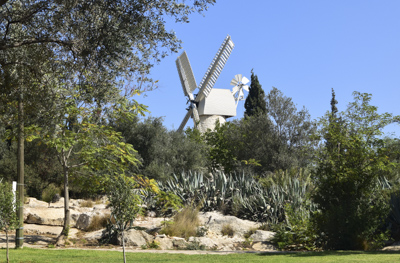
Today was my day to explore Jerusalem on my own!  I wanted to visit the Armenian Quarter in the Old City, so I set off walking down the hill from the Dan Boutique Hotel along King David Street.  I passed the Montefiore Windmill built in 1857.  It’s a small museum today.
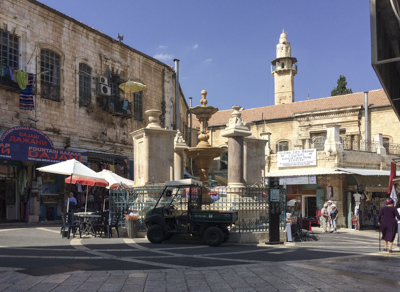
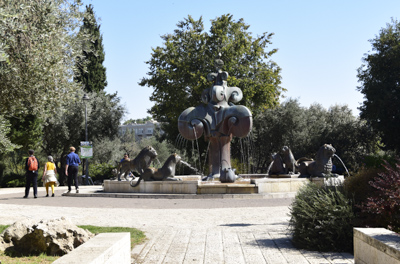
I also saw the Lion’s Fountain in Bloomfield Garden which symbolizes peaceful coexistence between the many diverse populations of Jerusalem.  Designed in 1989 the sculpture features the Tree of Life in the center with a dove on top, surrounded by lions.
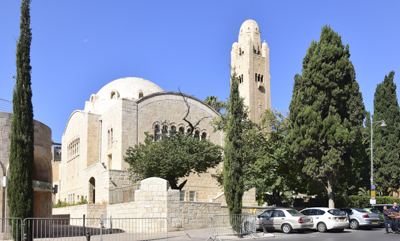
Further down the street was the Jerusalem International YMCA built in 1924.  It is an Art-Deco historic building designed by Arthur L. Harmon, who also designed the Empire State Building.
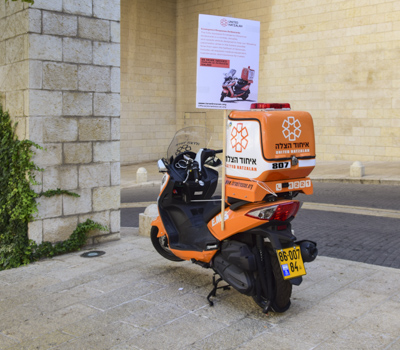
Rafi had told us about emergency scooters which are called as first responders to accidents or other emergencies when ambulances aren’t fast enough to get through heavy traffic.  I saw one outside the King David Hotel.  Great idea!
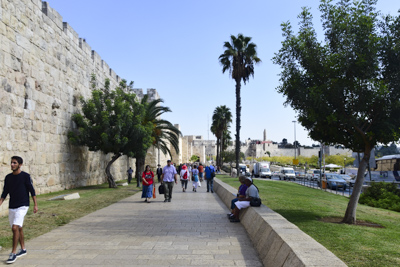
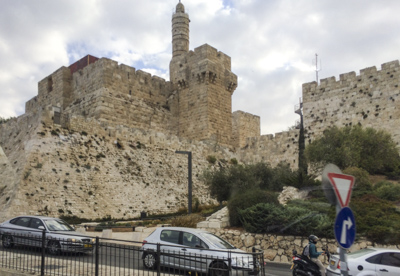
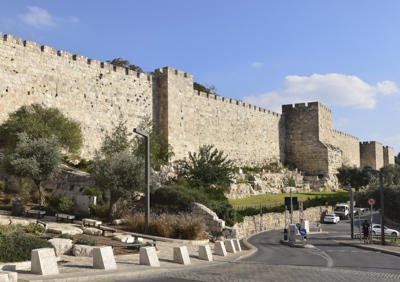
I turned right onto Yitzhak Kariv Street and I could see the walls of the Old City and King David’s Tower.
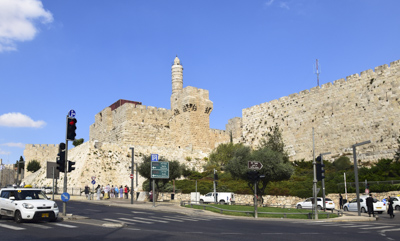
“Jaffa Gate” is more of an large opening in the wall big enough to allow cars and many people to enter the Old City, rather than a “gate.”
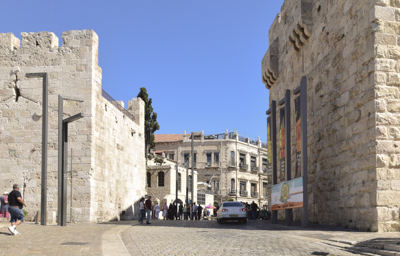
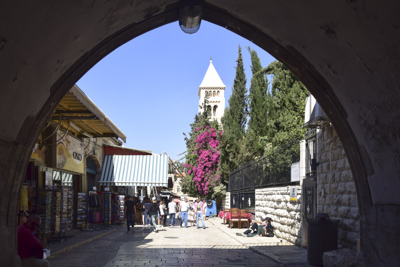
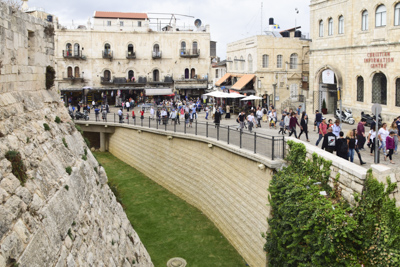
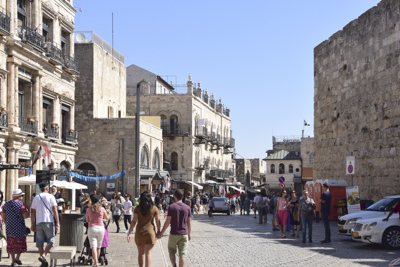
As I walked through Jaffa Gate I felt like I was in a medieval European city.  There’s a small hotel on the left of the gate.  Further on there are cafes, restaurants, souvenir shops, and many people.
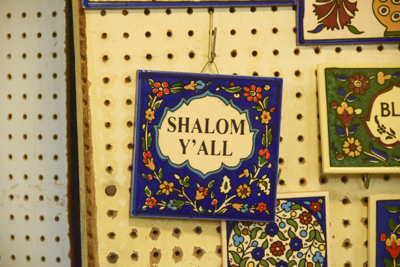
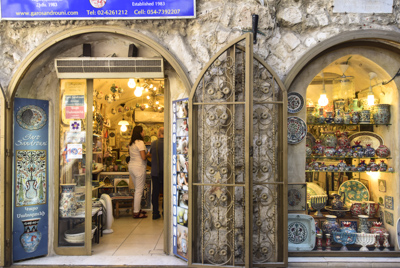
I remembered the location of the Armenian Quarter from our previous walk in the ancient city.  I stopped into one of the ceramic shops and asked for directions to St. James Church.  The soft-spoken woman was very helpful but I learned that the church is only open from 6:30-7:00AM and 3:30-4:00PM.
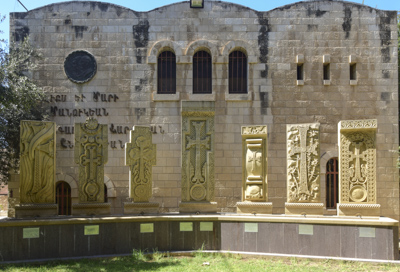
I went across the street to the seminary and spoke to the guard.  He accompanied me into the peaceful garden and showed me the beautiful stone “khachkars.”  These are large Armenian memorial stones carved in the shape of a cross. 
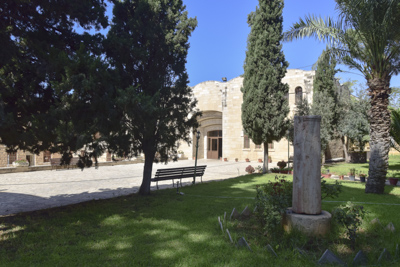
The seven khachkars were memorials which represented different regions of Turkey where the Armenian Genocide occurred in 1915.  The second from the left was from Sebastia where my grandparents were born.
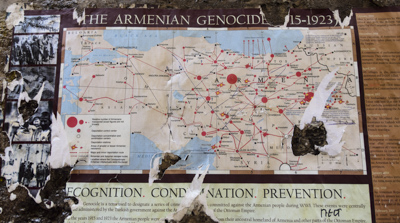
The poster in the photo above shows a map of Turkey with red dots representing the number of Armenians massacred or deported from specific areas.  Sebastia is the largest red circle on the map.

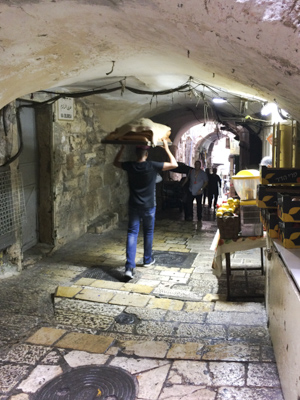
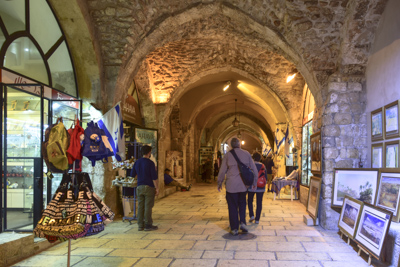
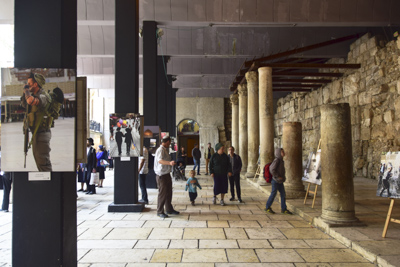
I wanted to see the interior of St. James Armenian Church, so I had to wait a couple hours.  I decided to explore the Old City of Jerusalem.  I walked through the Jewish Quarter but it was mainly closed due to the holiday of Sukkoth.  I continued on to the Muslim Quarter.  Despite the labyrinth of narrow streets, the Old City is easy and fun to explore.
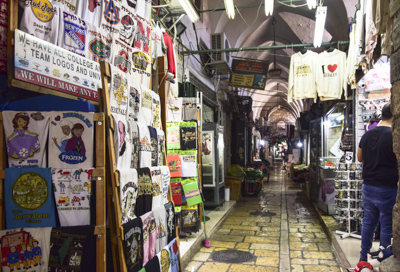
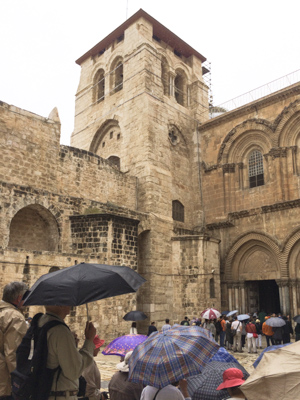
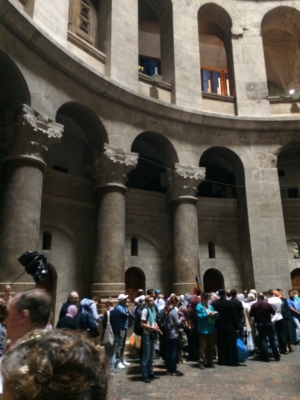
I walked all the way to the Christian Quarter and followed signs to the Church of the Holy Sepulcher.  It was not as crowded as it had been on my previous visit, so I went in to take better photographs.
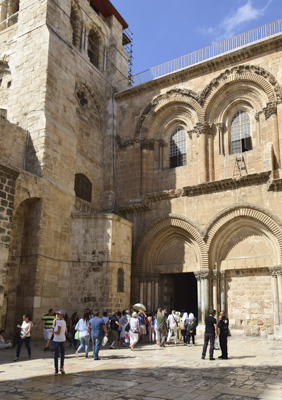
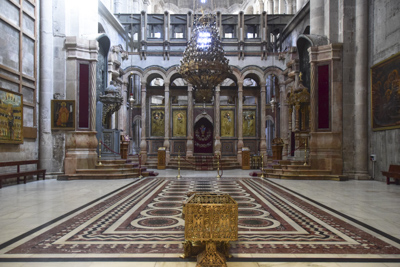
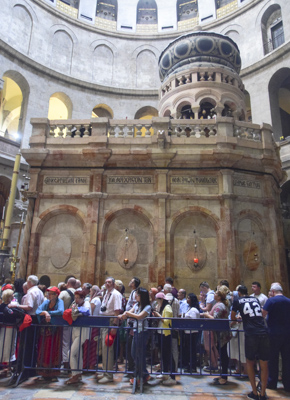
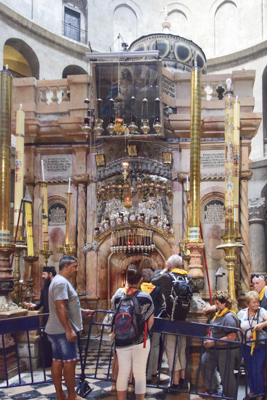
I was able to take a picture of the side of the marble shrine which holds the empty tomb and the front entrance. The line was a lot shorter than the previous day.
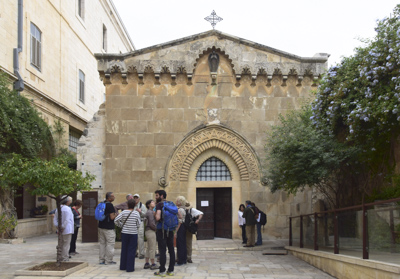
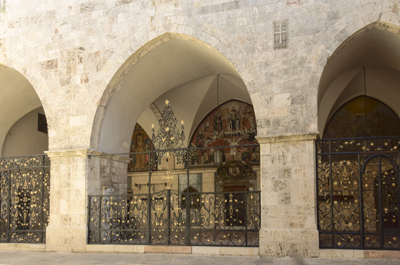
I walked back to St. James Armenian Church and waited just a few minutes for the priest to open the doors of the sanctuary.  It was built in the 12th century and named for James, the brother of Jesus.  I entered through the hand-carved portals with a few tourists and some local parishioners.
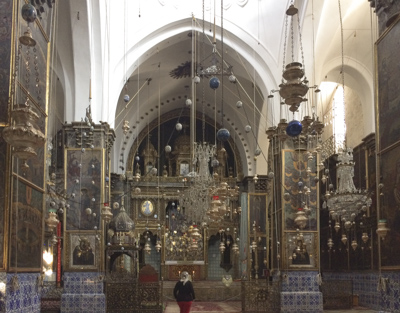
The interior was incredibly beautiful.  The sanctuary had no electricity and was illuminated by the many lanterns which hung from the ceiling.  Ancient paintings depicting early Christian scenes decorated the walls.  Beautiful Armenian carpets covered the marble floors.
At exactly 3:30 one of the priests read the bible from an elevated booth.  Afterwards, several Armenian Bishops, priests, and a dozen seminarians processed into the sanctuary and performed the service. The seminarians chanted and sang religious songs and prayers, their voices resonated throughout the church.
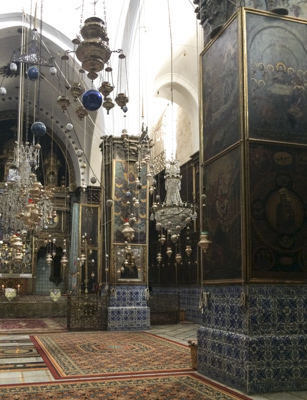
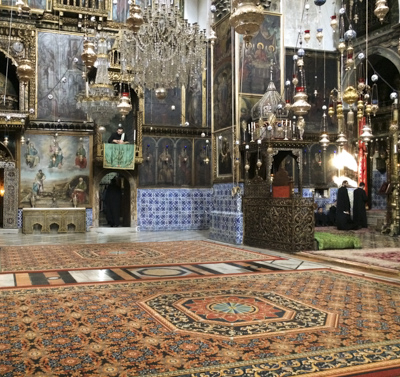
It was incredible to experience a service at St. James Church.  I happily went back out into the brilliant Jerusalem sunlight and walked back to the Dan Hotel.
Another fantastic day in Israel!
 

City of David to Machaneh Yehuda Market

October 11th, 2017

Wednesday – October 11, 2017

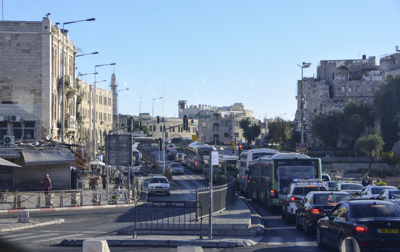
We drove slowly around the  wall of the Old City in rush hour traffic.  It was a glorious morning with a bright sun and cloudless sky.  Although my brain was focused on history and archeology, modern Jerusalem was always there reminding me that the city is vibrant, fresh and continuing to evolve and very contemporary.

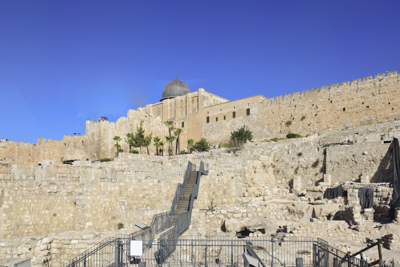
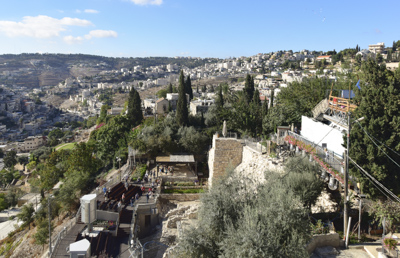
The bus parked on the road under the silver-domed Al-Aqsa Mosque, on the southeastern side of the Old City, near the entrance to the City of David excavation site.  We began our tour high above the ruins overlooking a large Palestinian neighborhood.  The City of David is controversial for its location in the Arab territory and is seen as an attempt to establish an Israeli presence in East Jerusalem.

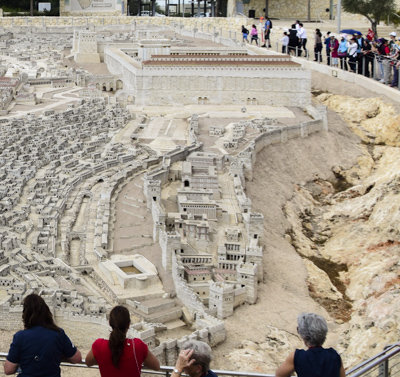
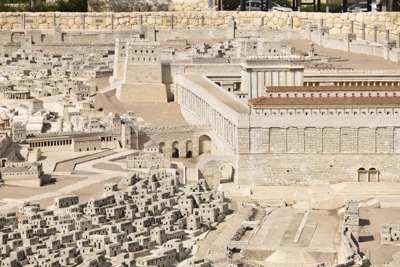
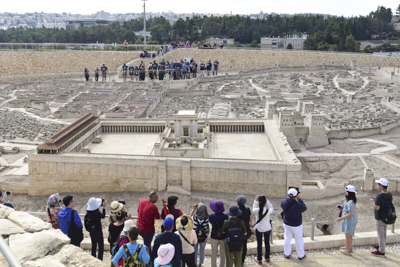
I remembered the geography of the site from our visit yesterday to the Israel Museum.  The Model of Jerusalem during the Second Temple Period showed buildings in this area.  The City of David is the walled strip of buildings leading down from the Temple Mount in the center of my photo below.

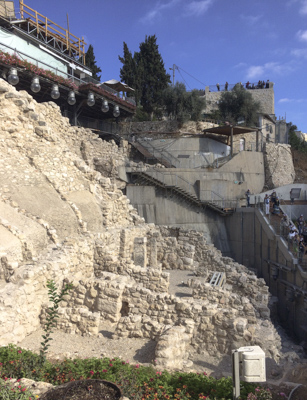
The biblical City of David is supposed to be the original ancient settlement in Jerusalem attributed to Judean kings.  Excavations have found shards of pottery and other early artifacts from about 4000 BC.  It is an important archaeological site which provides more historical information about the early development of Jerusalem.

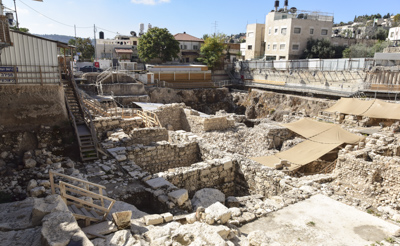
After we climbed around the excavation site, we crossed a street to another dig which had been the former Giv’ati parking lot.  Among discoveries at this site was an ancient building believed to have been a first century palace, a hoard of 264 gold coins minted during the Byzantine period, and a Roman onyx cameo.

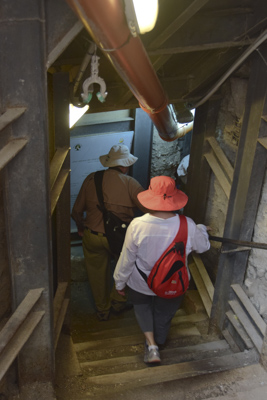
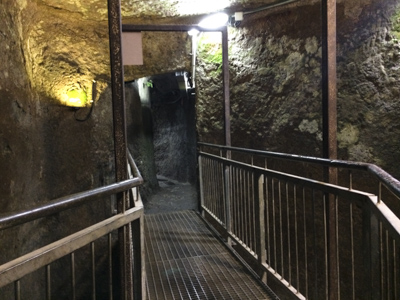
We walked carefully around the dig and entered the Central Drainage Canal which dates from the end of the 1st century BC.  This is an underground tunnel connecting the west side of the Temple Mount with Shiloah Pool (a ritual pool).

When Herod rebuilt and enlarged the Second Temple, this drainage facility was constructed to drain runoff rainwater.  Today, tourist can walk the entire 650 meter length of the tunnel.

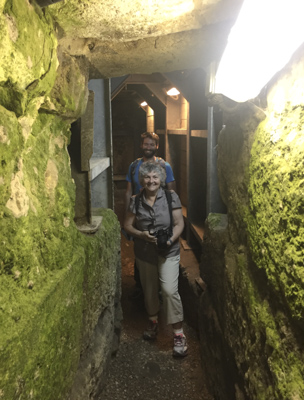
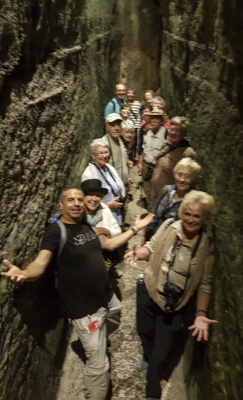
The tunnel wasn’t too creepy, except for the damp moss-covered walls.  That’s Alon, the tour guide, behind me as we carefully walked through the tunnel.

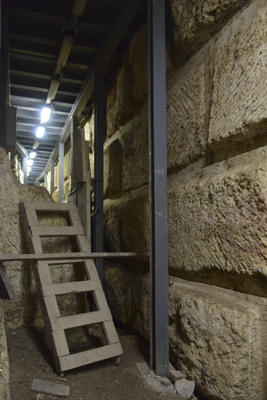
The tunnel actually continued to the foundations of the Western Wall.  We recognized King Herod’s beautifully crafted blocks of stone.  A sign said the Wall was set on natural bedrock.

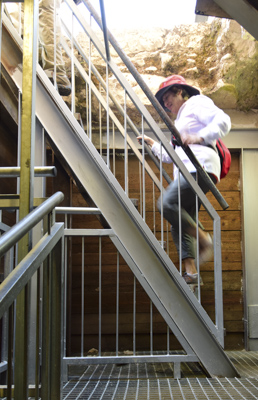
Surprise! Surprise!  I was surprised to recognize the location of where we were when we climbed the stairs up to ground level.  We were inside the wall of the Old City.   I remembered it from the model at the Israel Museum when I took photos of the Temple Mount.  Also, Rafi pointed out the arches on the model.

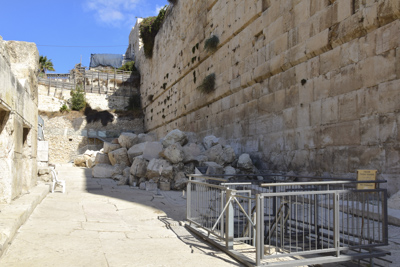
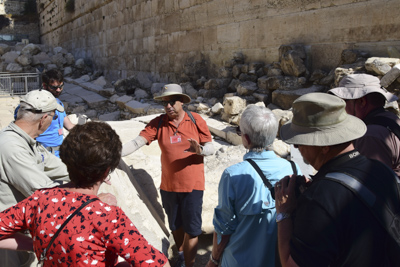
We were just under the Temple Mount facing another part of the Western Wall which was just beyond a high barricade.  Opposite was the modern Jewish Quarter.  

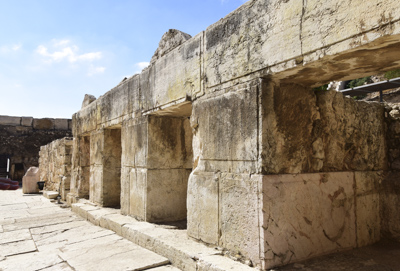
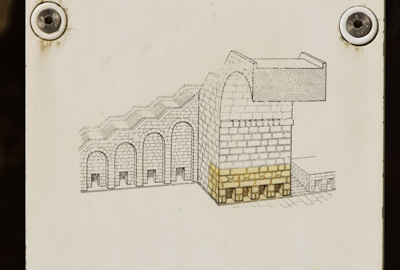
Notice the arches in the center of my photograph.  Today we were standing just under the Temple Mount wall near the place where the arches had been 2000 years ago.

There had been a wide walkway above the place we were standing to allow people, horses, and wagons access to the Temple.

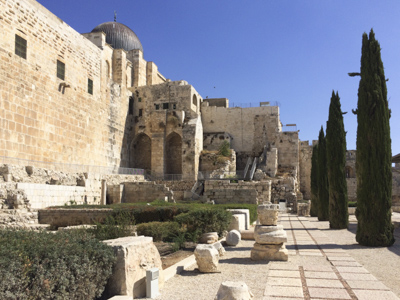
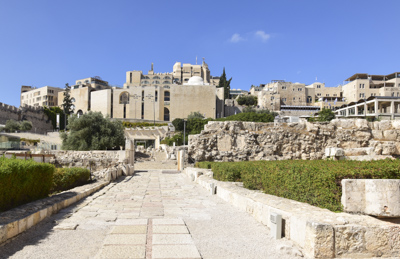
Rafi explained details of the site and then we walked around the corner to the southern side of the Temple Mount wall.  As you can see from the silver dome of the Al-Aqsa Mosque, we were almost back to where we started this morning

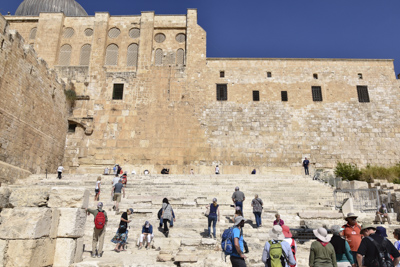
A little further on and we came to the “Southern Steps” also known as the Ophel Ascent. This is a set of stairs which led into the temple and an open space with ritual baths where pilgrims entered the Temple Mount 2000 years ago.  Rafi said it was a holy place to some Christians.

We walked toward the modern Jewish Quarter and out through the Dung Gate and back to modern Jerusalem traffic.  We drove to Machaneh Yehuda Market for an interesting lunch.

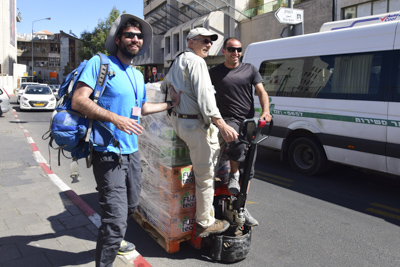
Larry caught a ride on a small beer delivery truck near the market:

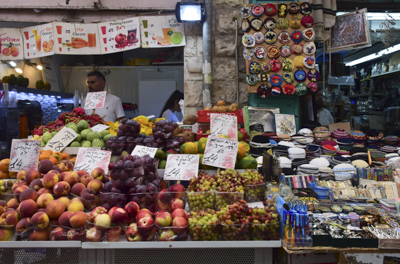
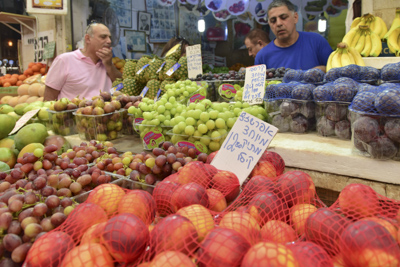
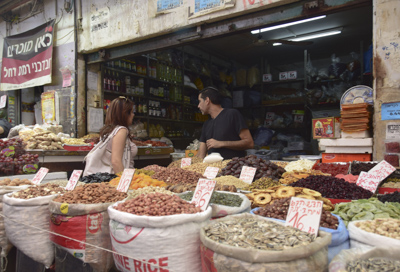
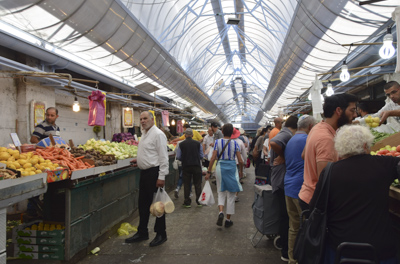
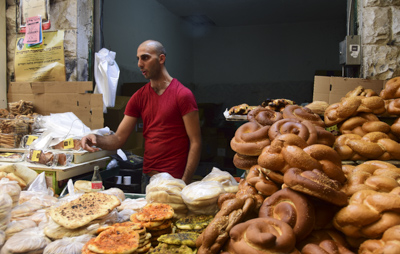
The market, also known as Mahane Yehuda or The Shuk, was established on Jaffa Road in 1887 and named after one of the founder’s brothers, Yehuda.

Most of our group had lunch with Rafi and Alon and then took the bus back to the hotel.  We had a free afternoon.  Doris, Ruth, Cathy and I stayed in the market to explore and have lunch on our own.  I love these outdoor markets, so this was a great way to spend an afternoon.


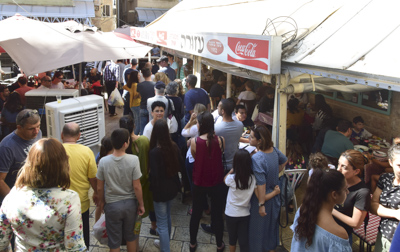
Many locals were shopping for the Sukkoth holiday.  We walked around the crowded market and explored the alleyways and interconnecting streets.  Ruth had several restaurant recommendations and we found one of them: Azura.   There was a long line but our patience was rewarded by a delicious lunch.

After lunch, we shopped for some munchies for a picnic supper tonight with our group members.  Then walked through the busy market back to the main street and back to our hotel.  It was a long walk and it took a while, but it was fun seeing modern Jerusalem on our own.

This had been another amazing day in Jerusalem!


Jerusalem: Yad Vashem to the Dead Sea Scrolls

October 10th, 2017

Tuesday – October 10, 2017

I negotiated with a desk clerk at the Dan Boutique Hotel to have my laundry done at a reduced rate, so I was happy.  Then we went out into another brilliant  sunny day; 19 degrees C and breezy.  Our destination was Yad Vashem – The World Holocaust Remembrance Center.

“I will put my breath into you and you shall live again, and I will set you upon your own soil….” Ezekiel 37:14  Carved in stone, the statement greeted us as we walked into the reception building.

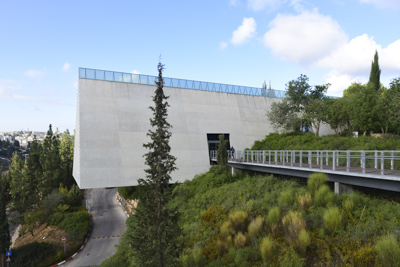
The Holocaust Museum was designed in the shape of a triangular prism and built into the top of a hill known as the Mount of Remembrance.  Yad Vashem is Israel’s memorial to the victims of the Holocaust. The museum was dedicated in 2005 and consists of a long corridor connected to 10 exhibition halls, each describing a different chapter of the Holocaust in chronological order.

Photography was not permitted inside the museum.  One million visitors go the Yad Vashem annually to learn about the deplorable events of the Holocaust and remember people who died under tragic and horrendous circumstances.  The exhibits in the museum are excellent with videos, memorabilia, artifacts, and maps.  Walking slowly through the chronological events was extremely sad for me.

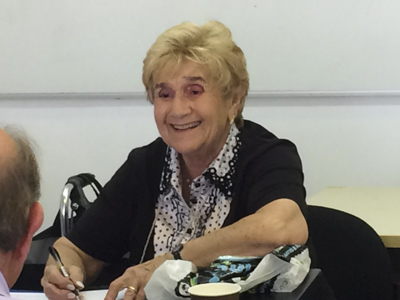
After going through the museum, we met with a survivor of the Holocaust.  She had just published her memoirs and related the story about her childhood in Poland, losing her parents and siblings, and finally being rescued from a concentration camp when she was ten years old.  She had lived in Denmark before moving to the United States.  She eventually married and had four children, twelve grandchildren, and now has 22 great grandchildren.  She is a true survivor!

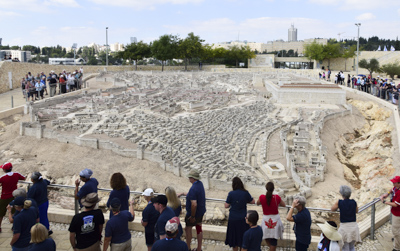
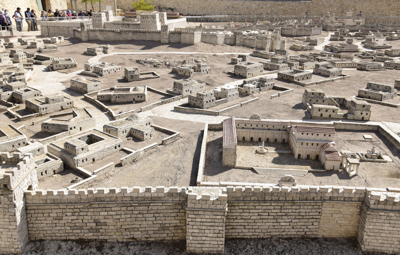
Afterwards, we drove to The Israel Museum which is a huge complex of art galleries and archaeology museums.  Our first stop was the Model of Jerusalem during the Second Temple Period.  This is a scale model of the city prior to its destruction by the Romans in 66AD.

It was a fantastic model of Jerusalem, when the ancient city was more than twice the size of the Old City today.  After this time period, the Great Revolt against the Romans took place and Jerusalem was destroyed as well as the Temple.

The model was completed in 1966 and relocated to the museum in 2006.  According to a plaque, the model is continuously updated as more archeological excavations are uncovered and improve scientists’ understanding of ancient Jerusalem.

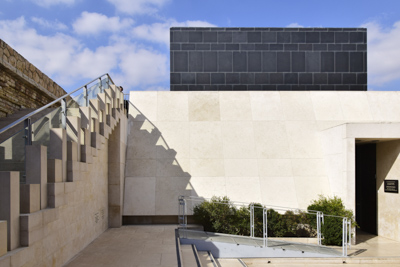
Entrance to The Shrine of the Book:

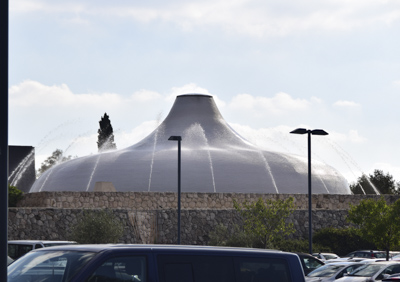
Then we crossed the street and went to the Shrine of the Book where select pages of the Dead Sea Scrolls were on display.  These are the oldest biblical manuscripts in the world, dating from 3rd century BC to the 1st century AD.  900 scrolls were discovered in 1947 in eleven caves near Wadi Qumran, 28 miles east of Jerusalem near the Dead Sea.  This was one of the most important archeological finds in Israel.

The Shrine of the Book building, opened in 1965, and was designed to resemble a pot in which the scrolls were found.  Two-thirds of the building is below ground level.  The scrolls are displayed on a rotating basis.  Also on display was the Aleppo Codex, from the 10th century, believed to be the oldest Bible codex in Hebrew.

Later in the evening, our group went to the home of an Ultra-Orthodox Jewish family for dinner.  We met the young couple, their two year old son, their rabbi, and other friends and family members.  They spoke openly about their faith and their roles in the family, their community, and in Israel today.

It had been another amazing day in Israel!
Old City, Jerusalem

October 9th, 2017

Monday – October 9, 2017

Today we entered the Old City of Jerusalem which is a walled city located within the heart of the modern metropolis of Jerusalem.

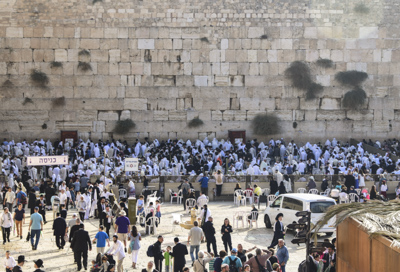
We entered through Jaffa Gate, which is one of seven gates, and walked through a labyrinth of ancient alleyways with other tourists, pilgrims, and local religious people.  The passageways opened to a wide plaza to reveal the Western Wall.  The wall was originally erected as part of the expansion of the Second Jewish Temple by Herod the Great in 19 BC.

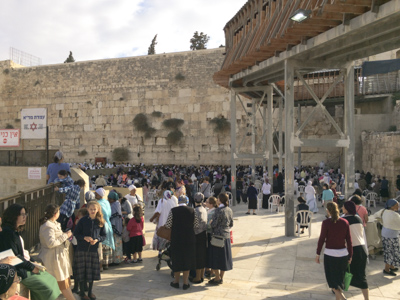
The wall is the holiest place where Jews are able to pray in Israel.  We walked through security and our bags were put through x-ray machines.  Here is a view of the Western Wall from the stairs:

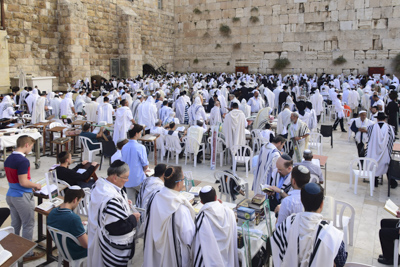
Men’s section:

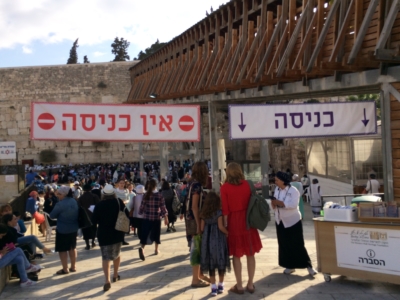
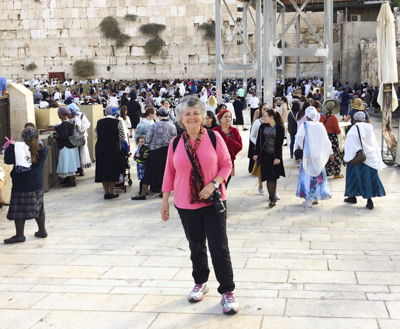
The Western Wall of the Temple Mount is one of the most significant remnants in Jerusalem from the Second Temple which was destroyed about 2000 years ago.  Entrance to the women’s section:

Inside women’s section:

The family below flew all the way from San Diego, California to have Josh’s Bar Mitzvah at the Western Wall.  The women of the family stood on benches to look over a barrier and watched Josh’s ceremony.

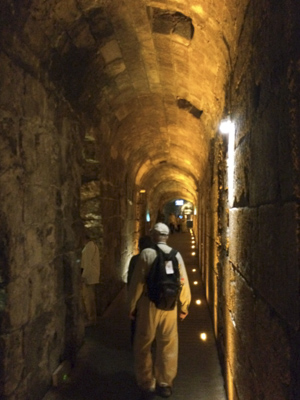
The Western Wall Tunnel is an underground tunnel and runs under buildings of the Old City of Jerusalem.   Walking in the Western Wall Tunnel:

Religious Jews have access to underground portions of the Wall and pray there:

The total length of the tunnel is 485 meters (1600 feet) which is significantly more than the 60 meters (200 feet) of exposed wall in the plaza at ground level.

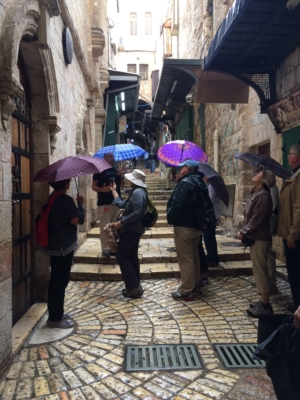
It began to rain as we walked along the Via Dolorosa (Way of Sorrows). This is believed to be the path that Jesus walked on the way to his crucifixion.  The Stations of the Cross refer to a series of images depicting Jesus on that day.  We followed the 14 Stations of the Cross:

The Stations of the Cross are located primarily in the Arab Quarter of the Old City.  Walking through that quarter is fun because of all the colorful shops.  It’s a lot like any Middle-Eastern Souq.  

The church of the Holy Sepulcher also called Church of the Resurrection is located in the Christian Quarter of the Old City of Jerusalem.  The church contains two of the holiest sites in Christianity:  the site where Jesus was crucified and Jesus’s empty tomb, where he is said to have been buried and resurrected.

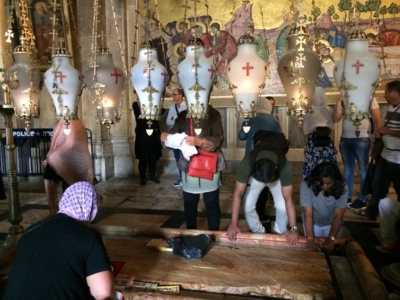
There was a very long line around the inside of the rotunda to get into the Aedicule.  This is the marble chapel which encloses the tomb and a fragment of the stone that sealed the tomb.

Stone of the Anointing:

The church was very crowded and it was difficult to see very much or take decent photographs.  However it was a very interesting experience.

We had lunch in the Arab Quarter at a restaurant called Dajani as the noon Call to Worship was broadcast from a nearby minaret.

We walked through the ancient winding alleyways of the Old City and stopped by the modern Jewish Quarter.  We also visited the Room of the Last Supper and King David’s Tomb.

We left the Old City of Jerusalem by the Jaffa Gate and passed the Tower of David, also known as the Jerusalem Citadel, built in 1310 by  Mamluk sultan and expanded in 1547 by Suleiman the Magnificent.

At night we returned to the Tower of David to see an historical light & music show.  It was very well done.


Golan Heights to Jerusalem, Israel

October 8th, 2017

Sunday – October 8, 2017

Sunday is a workday in Israel since Shabbat is celebrated Fridays and Saturdays.  Most of the other guests at our kibbutz had gone home on this workday, so our Sunday was quiet and peaceful.  It was a lovely morning; the sun was bright and birds were chirping happily.

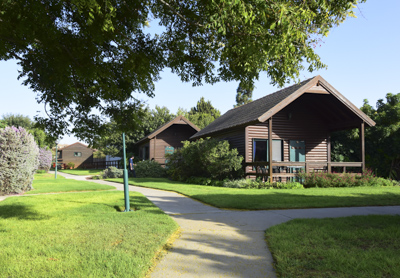
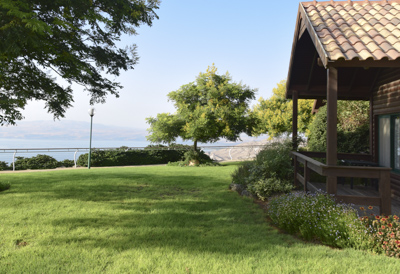
We were staying at Kibbutz Kfar Haruv on the Golan Heights at their Peace Vista Country Lodge – Mitzpe Hashalom, in Hebrew.  The community manages 27 comfortable rustic cabins for Israeli and international tourists.  Several of the knotty-pine cabins are located on the edge of the 1700′ cliff with spectacular views of the Sea of Galilee and the western hills in the distance.

One nice feature of staying at Peace Vista Lodge is that a huge continental breakfast is delivered to each cottage in the morning.  Home baked pastries with cheese and strong coffee was a wonderful way to start the day.  This morning we were scheduled to tour the grounds of the Kibbutz and help make lunch.  One of the members gave us an excellent tour.

Kibbutz Kfar Haruv was founded in 1973 and continues the kibbutz tradition as a collective community.  The Kibbutz movement began in Israel in 1909 as agricultural communities combining socialism and Zionism.  In recent decades, some kibbutzim have been privatized and changes have been made in the communal lifestyles.  Kfar Haruv has a population of 387 people.

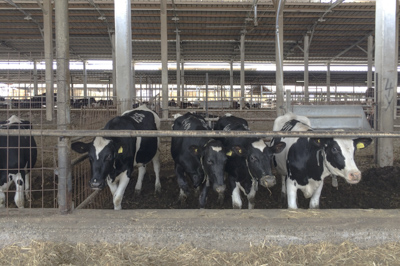
A large dairy is one of the successful businesses which the Kibbutz owns and runs.  We visited the cows and also saw many calves.  The settlement also tends orchards of almonds, avocados, and peaches.  The international community considers Israeli settlements in the Golan Heights illegal under international law, however the Israeli government disputes this.

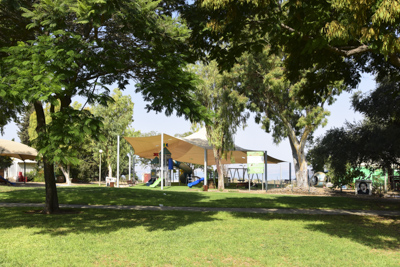
On our tour we saw homes, schools, playgrounds, and the medical center for the residents.  The grounds were very beautiful and well maintained.

The kibbutz owns and operates the A.R.I. factory which manufactures hydraulic equipment.  This is the largest employer of the settlement and provides the most income to the members.

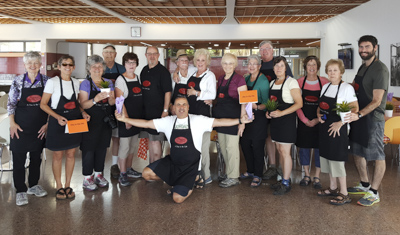
After our tour, we returned to the main building which houses the cafeteria and kitchens.  The OAT group pitched right in and helped the kibbutz by peeling many pounds of potatoes and carrots.  Afterwards, we had a tasty lunch and said our goodbyes to the lovely friendly kibbutz members we had met.

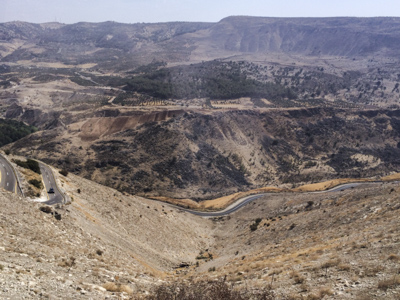
We set off in our tour bus down from the Golan Heights to the vast Jordan Valley, through the desert on our way to Jerusalem.  Notice the hair-pin turn on the left in the photo below:

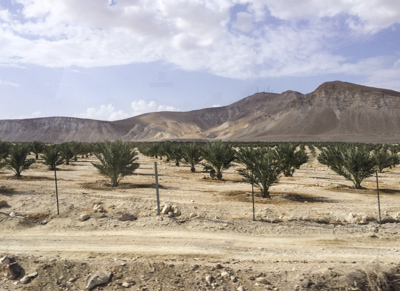
The terrain changed along the valley as we traveled southbound.  Below are young date palm trees.

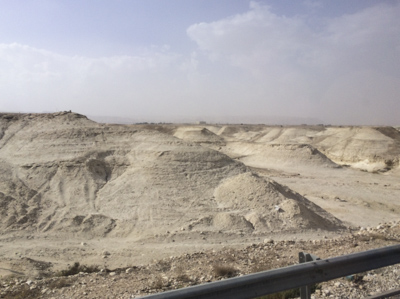
We passed many miles of white-sand desert.

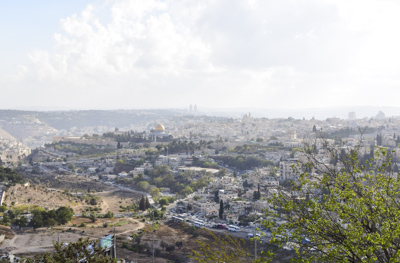
When we ran into a significant amount of traffic, we knew we were near Jerusalem.  The bus drove up to the top of a hill and we disembarked to get our “first view” of the famous magnificent city.  Although the sky was overcast, the gold Dome of the Rock Mosque was unmistakable and it glowed.

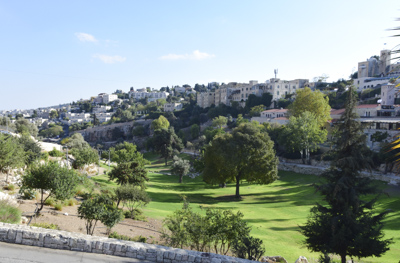
The walled Old City is on top of a hill and the rest of the city spreads out along  the other hills.  The most surprising thing about Jerusalem is that it’s built on so many steep hills.

We checked into the Dan Boutique Hotel and relaxed a little.  About 6:30 we walked to the old railroad station near the hotel for dinner.  The Jerusalem Railway Station opened in 1892 and was the last stop on the Jaffa-Jerusalem line.

After extensive renovations, the station reopened as a cultural and entertainment center in 2013.  We enjoyed a tasty feast of many dishes: hummus, baba ganoush, stuffed peppers, pasta, fries, kebabs, and decent pizza.

This had been another thought-provoking and amazing day!