Echmiadzin

July 18th, 2013

Thursday, July 18, 2013

We took another Hyur tour excursion today to see the seventh century churches of St. Hripsime, St. Gayaneh, and the Cathedral of Echmiadzin.  These historical sites are located approximately 30 minutes west of Yerevan.  The road leading to Echmiadzin was very well paved and straight. This was in sharp contrast to the very poor road which was filled with huge potholes and cracks leading to Garni Temple and Geghard Monastery yesterday.  Interestingly, the Hyur tour bus drove past a series of newly built casinos just on the outskirts of the Yerevan.

The Church of St. Hripsime

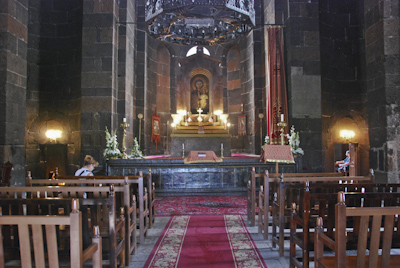
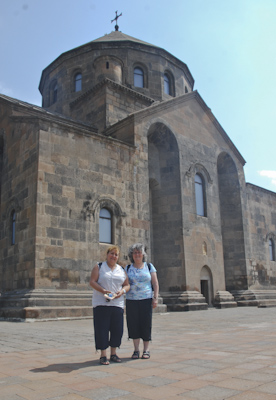
The Church of Saint Hripsime was built in 618 AD and according to the guide, had a major influence on Armenian architecture which followed.  The two-tier bell tower was added in 1790.  Hripsime was one of 36 religious women who were stoned to death for their religious convictions.
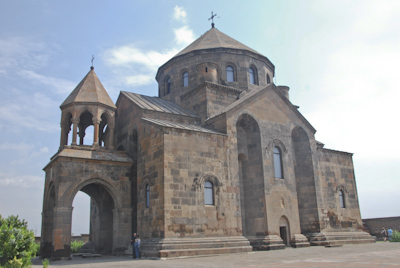
Rear View of St. Hripsime with Bell Tower

Another View

Interior Main Altar

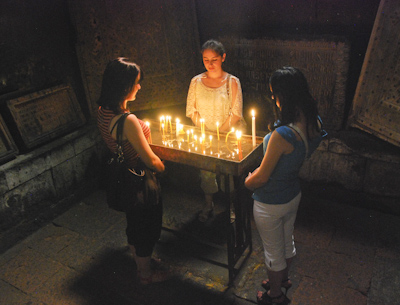
Light a Candle; Say a Prayer

Francoise & Donnie at St. Hripsime

The church of  St. Gayaneh is a domed basilica which was built in 630 AD and restored in 1652.  The architectural style is much different from that of St. Hripsime which was built about the same time.
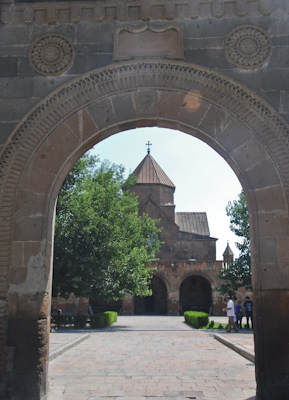
Saint Gayane Church

Exterior of St. Gayane Church
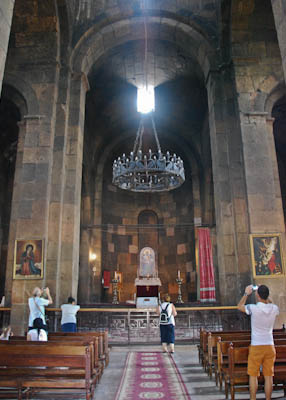
Interior of St. Gayane

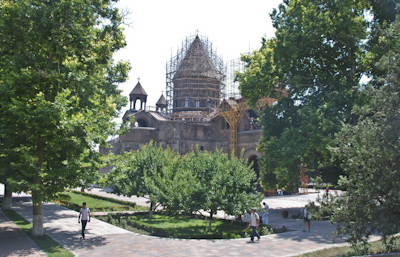
Echmiadzin is the seat of the Armenian Church and is the holiest religious site in Armenia and to Armenian people around the world.  It is more than 1700 years old and is the oldest surviving Christian site in the country.  The Echmiadzin complex consists of several buildings, including the main cathedral, a museum, residences for clergy, a new baptistry, and two other churches nearby.  UNESCO recognized the Echmiadzin complex as a World Heritage site.

Modern Gate to Echmiadzin Complex

Echmiadzin Cathedral

According to the guide, there was a major reconstruction of the the church in 484 AD.  The original wooden dome was replaced in the 7th century by the current stone dome.  The three-story bell tower was added in 1658.

Symbolic Center of Echmiadzin

Treasures of Echmiadzin is a museum filled with chalices, illuminated bibles, robes of priests, relics, and other church related treasures.

Eucharist Dove

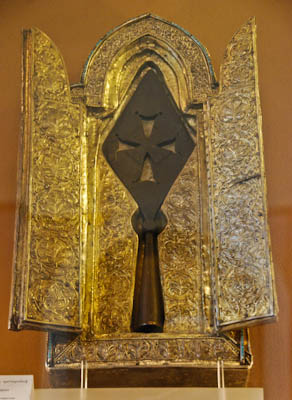
Legendary Geghard Spear

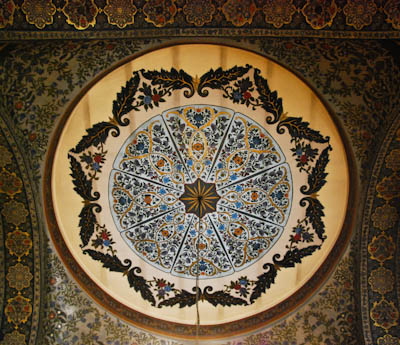
Persian Ceiling

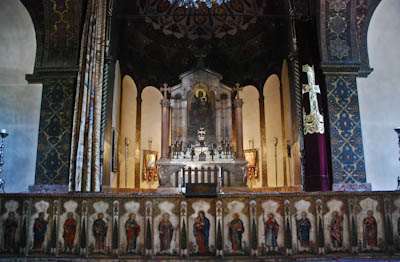
The Main Alter of Echmiadzin Cathedral

New Baptistry

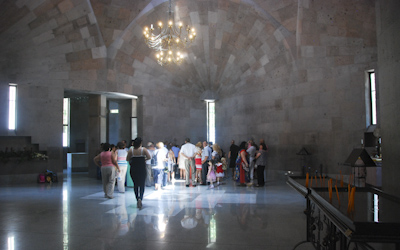
Interior of Modern Baptistry

Side View of St. Echmiadzin

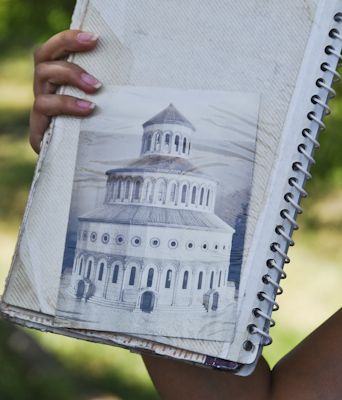
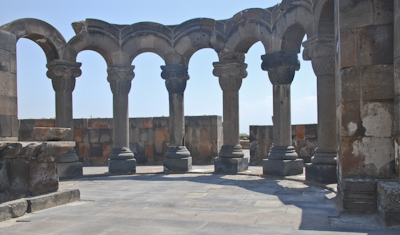
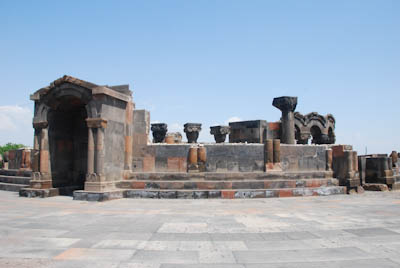
The group left the Echmiadzin Complex and made a stop to see the ruins of Zvartnots Cathedral.  Zvartnots was completed in 661 AD and is recognized for its unusual circular architecture.  When it was built, it looked like a giant three-tiered wedding cake.  The site is now a ruin of pillars and large stones.  The destruction was attributed to an earthquake which occurred in the 10th century.   
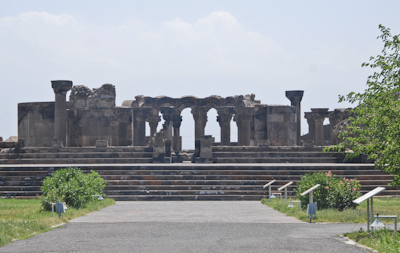
Zvartnots Cathedral Ruins

What Historians Thought Zvartnots Looked Like

Decorated Columns

Lower Tier of Columns

One of Five Remaining Entrances to Zvartnots
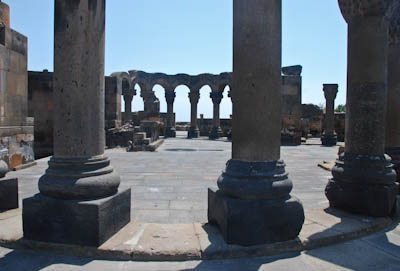
View Towards Mt. Ararat

The Hyur Tour group left Zvartnots and we returned to Yerevan by 4:00 PM.  Francoise and I crossed the Republic Square again and walked back toward the Europe Hotel.  The weather was very hot all day.  Someone said the temperature was today reached 42 degrees Celsius.  Which, by my calculations is about 107.6  degrees Fahrenheit.  “Shok eh!” as they say here in reference to heat.  It was refreshing to return to the air conditioning of the hotel.
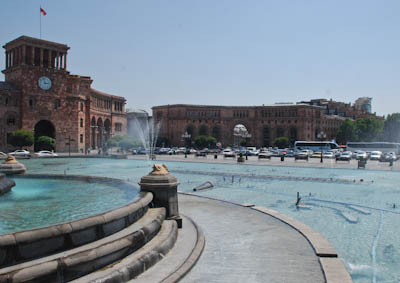
The Singing Fountain by Day

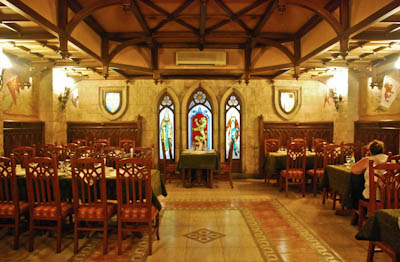
After a cooling break at the hotel, we walked to Ayas Kilikia Restaurant for dinner.  As the sun was setting, the temperature was cooler.  Ayas Kilikia was a very good family-owned restaurant which features live music in the evenings.  It was recommended to us by some people on the tour today.  The brochure for the restaurant states that “you will be transferred to Cilicia of the 14th century” by eating their food.  
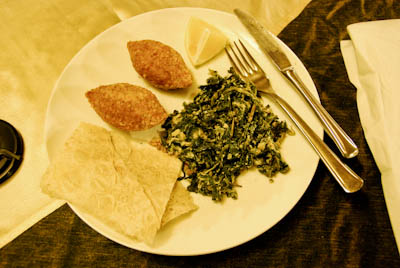
Keufta and Kale With Lavash

Interior of Ayas Kilikia

According to the menu, they use organically grown ingredients and their “cuisine includes historical Armenian national dishes.”   At the end of  our meals, we were offered glasses of Rose Brandy which was made by the chef.  The waitress said it was made from rose hips and was available for sale only at their restaurant.  Everything was very tasty and we planned to return to the restaurant if we had time.


Garni Temple and Geghard Monastery

July 17th, 2013

Wednesday, July 17, 2013

We had booked a tour today with Hyur Service, a local tourist agency, and arranged to take a group tour to visit Garni Temple and Geghard Monastery today.  Armenia is a very small country so it is feasible to use Yerevan as a base and take day trips out of the city to visit several important historical sights.

The Temple at Garni

The Temple was part of a fortress built in the first Century A.D. by an Armenian king and dedicated to a sun god.  The original complex included a palace, bathhouse, servants’ and guards’ residences, a church, and a meeting hall.  The temple is situated on a triangular piece of land with two sides along the steep Garni Gorge.  A thick wall had been built on the third side for to protect the fortress from invasions.


Garni Temple

Tilling the Soil

The Deep Garni Gorge

There are remains of an original bathhouse which been well preserved, although the roof is new.  This was the royal bathhouse for the king.

The Roman Bath

The interior of the bath has been restored to demonstrate how it was used.  The inscription on the floor was written in Greek and was translated as, “Work and gain nothing.”  The guide explained that historians believe that the inscription suggests that the craftsmen were not adequately paid for their services.

Interior  Mosaic

The Temple at Garni has been recognized by UNESCO for the preservation efforts by the Armenian government.

Tourists at the Temple

After the group’s explorations at Garni, we continued a short distance to Gerghard Monastery and Church.  UNESCO recognized this complex on its list of World Heritage sites.

Snacks on the Way to the Monastery

The surviving buildings of Geghard date from the 13th Century.  The Monastery was literally built into the side of a mountain and more than half of the interior floor space is located within the mountain.  The complex is also called “Ayrivank”, which means Monastery of the Cave.

The Inner Courtyard of Gerghard Monastery

The common name Gerghard refers to the monastery’s status as the original repository of one of the spears that was used to pierce the side of Jesus during the crucifixion.  Gerghard is the Armenian word for spear.  The legendary spear is now housed in the museum at Echmiadzin Cathedral.

Interior of the Main Room

Woman Being Baptized

The tour guide explained that since Armenian independence from the Soviet Union, many Armenian people are returning to the church and religious practices of weddings and baptisms.  The Armenian woman in the photo above chose to be baptized at Geghard Monastery.

Interior

Inner Chapel

Water that seeps through the walls of the mountain is collected in various pools.  People were touching the water and spreading it on their arms and faces.  Local legend advises visitors to throw coins into to pool to guarantee their return to Armenia.

Natural Illumination

Historians believe that the Monastery of Ayrivand may have been founded as early as AD 300 to 400.  Documentary evidence dates the monastery as far back as the 7th century AD.

Chapel Entrances

Cathedral Exterior

The main cathedral in the photo above was built in 1215.  The numerous chapels were illuminated only from sunlight coming through openings built in the thick stone walls and circular openings (“oculus”) in the middle of the ceiling of the high domes.

Standing in the Light

Yerevan, Republic of Armenia

July 16th, 2013

Monday, July 15, 2013

I met my cousin, Francoise, at Charles de Gaulle in Paris and we flew to Yerevan. The flight to The Republic of Armenia was another five hours in the air.  We arrived at 9:55 PM local time at Zvartnots International Airport.  As an American, I had to purchase a Visa to enter Armenia, so first we stood in line to exchange my dollars to Drams.  European Union citizens did not need visas.  There are about 420 Drams to one US Dollar, so I received about 20,500 Drams.  Afterwards, I waited on another line to purchase the Visa. The third line which was to pass through Customs, was the shortest and quickest.  Finally we passed through the doors to the waiting room.  Our distant cousins, Anahit and Gagik were waiting for us to take us to the Europe Hotel to begin our two-week stay in Armenia.  It was very kind and generous of Anahit and Gagik to meet us!

Tuesday, July 16, 2013

After a European breakfast at the hotel, Francoise and I went out to explore the neighborhood.  The Europe Hotel is located very close to the city center of Yerevan called Republic Square.  The ‘square’ is actually a large traffic oval surrounded by government offices, the central post office, a Marriott Hotel, the Museums of Armenian History, National Gallery of Art, and the famous “Singing Fountain”.

 Pink Buildings Around Republic Square

Government Building

Pedestrian Mall

We crossed Republic Square and walked along Nalbandyan Street to the Hyur Tourist Service office.  They were a reputable company which offered tours from Yerevan to historical sights outside the city.  We arranged two separate day-tours for this week to explore the small country of Armenia.

The Singing Fountain

The agent at Hyur Service recommended a nearby restaurant for lunch, the Tumanyan Pandok.  The weather was very warm and the restaurant was located below street level so it was much cooler downstairs.  We had stuffed grape leaves (dolma), eggplant & pepper salad (in the photo below), and Uzbek Pilaf.  Everything was delicious!

Georgian Salad for Lunch

We walked back to the Europe Hotel.  The temperature was very hot (41 degrees Celsius) and the air conditioning at the hotel was great!   The hotel was centrally located on a small quiet side street.  Our room was clean and comfortable and the entire staff was friendly and helpful.

Exterior of the Europe Hotel

 Anahit called to invite us out to see the city in the evening.  She and Karen drove us to The Cascade which was a sight to behold.  It was a multi-level modern art museum built into the side of a hill with interior and exterior stairs to the top.  There was also an escalator inside with art objects along the moving stairs.  The sculpture garden at street level was filled with modern art objects created by world-famous artists.

The Cascade

Francoise, Karen, Anahit

View of the Sculpture Garden From the Top

Top of the Cascade

As night fell, Anahit and Karen drove us to a really nice restaurant called Poplavok Jazz Cafe to have dinner and hear live music.  The temperature was much cooler near the fountain and the jazz was very good.  We sat and had a very enjoyable time.

Poplavok Jazz Cafe

Cool Evening & Cool Jazz

American Jazz Band at the Poplavok

Armenian Pizza

After a good supper of pizza, salad, fries, and veggies, we left and Karen drove us to Republic Square to join the people at the “Singing Fountain.”  The water sprays up to the beats of classical music. The crowd, a lively blend of multi-generational families and young people, cheered as the music played.

The Singing Fountain at Night

The Crowd Around the Fountain

Singing & Dancing Water

It was a very active and interesting first day in Yerevan.


Taam Tov – Tastes Good!

July 11th, 2013

Thursday, July 11, 2013

Jeff and I took the train to Manhattan to have lunch with CeeGee, my younger son. We walked from Grand Central Terminal west to the International Center of Photography on 43rd Street & Sixth Avenue to see the current exhibit which was The ICP Triennial. Every three years, the museum showcases contemporary photographers from around the world. The exhibit attempted to broaden the definition of photography and to expand the possibilities of the medium beyond any traditional conception of photography.  It was interesting and somewhat inspiring.

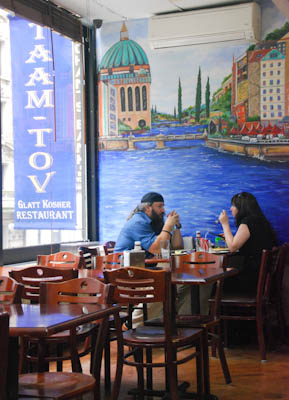
Good Taste – Taam Tov

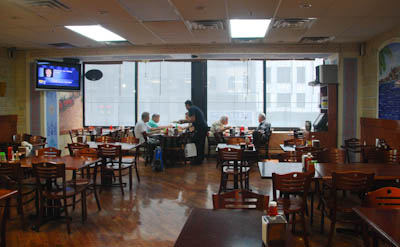
Afterward, we walked north to The Diamond District – 47th Street between 5th & 6th Avenues – to the only Kosher Uzbek restaurant in New York City, Taam Tov. We climbed the steep linoleum-covered stairs up to the third floor to find several men waiting for take-out orders. One of the men held the door to the dining room for us and we entered. CeeGee and I had read on-line that the restaurant replaced a Chinese restaurant and the management had not changed the Asian décor. We were just a little disappointed to find a renovated space with newly painted walls decorated with Mediterranean murals.

Green Tea

We arrived after the traditional business lunch hour, so there were plenty of tables for us. The food at Taam Tov, which literally means ‘taste good’ in Hebrew, represents the flavors of Bukhara, a provence in Uzbekistan.  Bukhara is located on the ancient Silk Road and has been inhabited for 5000 years.  The roots of Jewish people settling in Bukhara reach back more than 2500 years. The community was separated from other Jewish people but managed to survive in spite of innumerable odds.  As a result, the people created a unique culture of rich literature, beautiful music, tasty food, and other traditions.

Casual Interior

We began our lunch with a delicious cold baba ganoosh and a round loaf of tasty lepeshka bread. Bullwinkle had the pelmene soup which had small meat dumplings in a rich spiced broth. We shared salmon kebabs and vegetarian pilaf, both of which were delicious. CeeGee took home two home-baked pastries to eat later. We enjoyed everything and hope to return soon to try other items on the menu.

Bright Lights and Stardom

After a hearty lunch, we walked to Broadway to visit the lobby of the landmark Embassy Theater.  The theater opened in 1925 and the lobby has been restored and is used as the Times Square Visitors Center. On display is the New Year’s Eve illuminated ball which descends a pole on the roof of the old NY Times Building at midnight to mark the new year.  There are also other small exhibits about the history of Times Square.
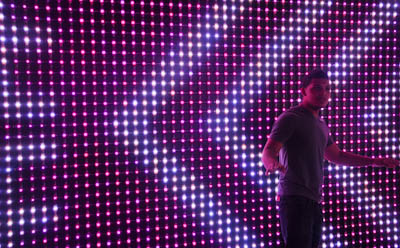
The Naked Cowboy

Back out among the crowds of tourists on Broadway, we walked south to 42nd Street. That small part of Broadway has become a pedestrian mall with chairs and places for tourists to sit and ponder why they thought going to NYC in the heat & humidity of summer was a good idea.

Tourist Bus

We were able to escape the tourist crowd and find air conditioning on the Broadway subway line downtown to 34th Street. Bullwinkle had to pay homage to his favorite temple of consumerism: B & H Photo. Tired, hot, and exhausted, we found coolness and comfort at a coffee shop called Gregory’s Coffee. Refreshed, we returned to Grand Central for the train ride home to green suburbia. It had been a full and very good tasty day!

Monkey Busyness

July 8th, 2013

Monday, July 8, 2013

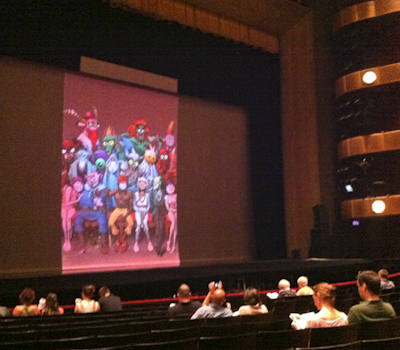
Last night, Jeff and I drove to Manhattan to see a performance of Monkey: Journey to the West at Lincoln Center. It was a modern operatic retelling of a 16th century Chinese novel with acrobatics, animation, and martial arts. The singers sang in Mandarin to the accompaniment of a full orchestra.

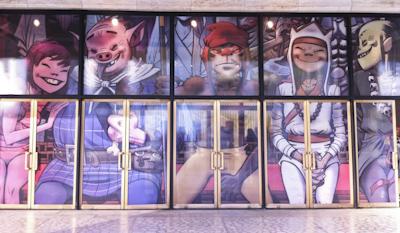
Doors of the Theater at Lincoln Center

It was an epic tale of the arrogant Monkey King’s quest to find immortality. The Monkey had to accompany and protect the Buddhist monk, Tripitaka, on a journey to India to receive holy scriptures. The other characters on this pilgrimage were Pigsy (who suffered from lustfulness), Sandy (melancholy), and The Dragon Prince (carelessness) who had been turned into a white horse. Along the way, the characters battled many great perils and supernatural obstacles.

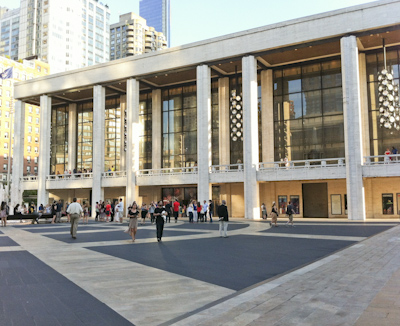
David H. Koch Theater

Monkey: Journey to the West utilized elements of traditional Chinese Opera, for example stylized movements and choreographed sword fights.  However, the colorful costumes and music were modern.  The singers had excellent voices especially the woman who played the trouser-role of Tripitaka. The acrobatics and contortionists, which reminded me of a simplified version of Cirque de Soleil, were entertaining. The animation was primitive by today’s computer graphics standards but added another mystical layer of visual complexity. In summation, I would say the performance was ‘interesting’. I wondered if Monkey: Journey to the West was a view into future entertainment for the current techno-savvy multi-tasking short-attention span youth of today.

Viewing Each Other

Nitty gritty: We had a reasonably priced light supper of soup & salad and sandwich at Indie located in the Elinor Bunin Munroe Film Center on 65th Street.

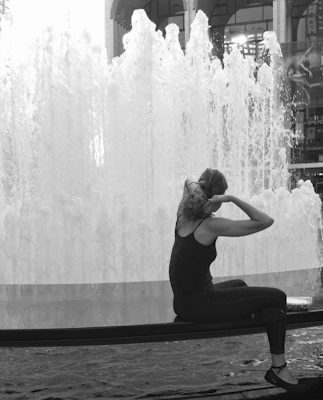
Fountain at Lincoln Center

Note: All photos were taken with my iPhone.