Across the Afsluitdijk and Back

September 12th, 2010

Rainy Sunday – September 12th

I can’t believe another rainy day in Delft, Netherlands!  We had a good European breakfast in the dining room of the Hampshire Hotel and were determined to continue with our plans to visit some new places in Holland.  We were going home on Tuesday and we wanted to enjoy our last two days.
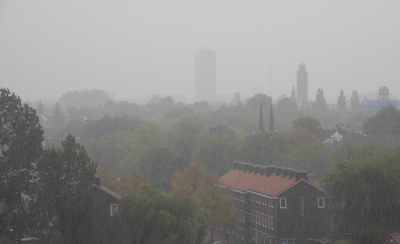
Morning view of Delft from our 7th floor balcony

The Netherlands is really a very small country and you can get almost anywhere in a couple of hours. Jeff and I wanted to visit the area north of Amsterdam called Wieringermeer Polder and see the Afsluidijk.  The word ‘polder’ means land reclaimed from the sea, lake, or marshland.  To create a ‘polder’, the area is enclosed with dykes and then the water is pumped out and the water level is regulated. Originally windmills pumped out the water, these were replaced by steam and diesel engines, and today electric pumps control the water.

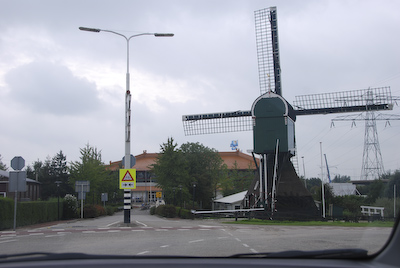
From Delft, we got on the A-4 and drove north.  Today, the countryside of the Netherlands is filled with a new kind of windmill which generates electricity.  I like this photo that I took from the car, along the A-4 of an old fashioned traditional wooden windmill next to two tall stark-white wind-turbines:
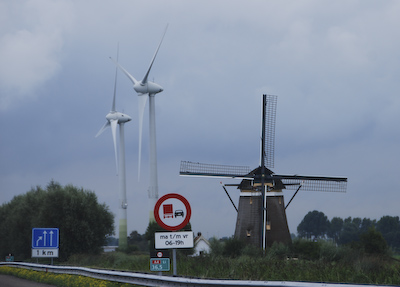
Old and New Wind Power

We continued north of Amsterdam along the two-lane road, the N-9.  This flat almost-straight road passes the shore villages along the North Sea.  The area is famous for its cheese auctions, herring fishing, and whaling in the 16th century.  It is also a seaside resort area of beaches with a number of hotels and restaurants.
Alkmaar is the largest city on the peninsula, with a population of 94,000 people.  It’s hard to believe that Alkmaar was besieged in 1573 by the Spaniards and Holland was under Spanish rule for almost a hundred years.  As the story goes, heavy autumn rain flooded the countryside and forced the assailants to withdraw. As a result, Alkmaar is credited with being the first town to resist the Spaniards.  Fortunately for us, the weather was clearing the further north we drove.
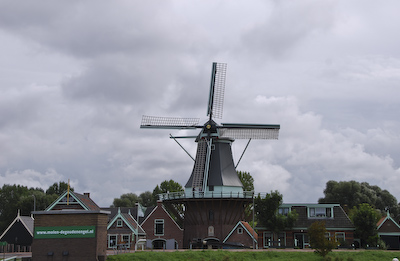
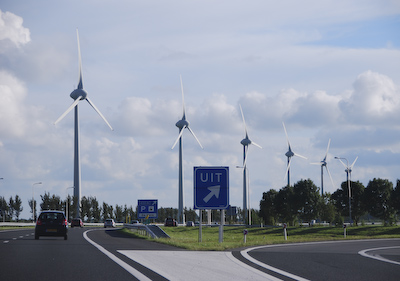
A windmill along the N-9

We drove all the way to the top of the peninsula, to a town named Den Helder.  We didn’t know what we would find there because there wasn’t much information in our Michelin Guide.  We were very pleasantly surprised to see a very appealing town and interesting things to do.  The guide said that Den Helder is the Netherlands’ chief naval base and naval ships could be seen at the docks in the distance.  At the end of the road, there is a ferry terminal which goes to Texel. This is the largest of the Wadden Islands which form a string of barrier islands protecting the northern part of the Netherlands from the ravages of the North Sea.  According to the Michelin Guide, Texel has several interesting villages.
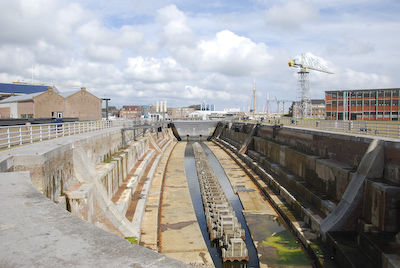
Dry Dock for a huge commercial or naval ship

Also in Den Helder are a naval museum, a national maritime rescue museum, an aquarium, several beaches, a nature reserve, and six forts which had been built by Napoleon.  Unfortunately, it was Sunday and most of these were closed, but we promise to return and explore this very interesting area in the future.
Our goal was to see and cross the famous Afsluitdijk and return to Delft before dark.  We continued on the road heading north. There was very little traffic, the weather had cleared, and because the land is so flat, one could see for miles.  It is a place where land, sea, and sky meet. The road of the Afsluitdijk lunges out into the blueness and  it visually cuts into the middle of the sea, with salt water on one side and fresh water on the other.
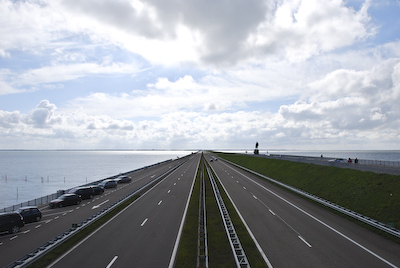
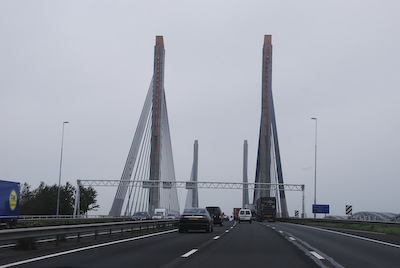
View From the Middle of the Bridge over the Afsluitdijk

The Afsluitdijk was built in 1932 as a huge barrier dam creating the outer Waddenzee and an inland freshwater lake, now known as the Ijsselmeer. Once the lake was enclosed, work began to create other polders and huge tracts of land were reclaimed.  The Afsluitdijk was a monumental project which was planned by Dr. Cornelis Lely in 1891.  It took backbreaking intensive labor to build the dyke which is 19 miles long, 330 feet wide, and is 23 feet above sea level.
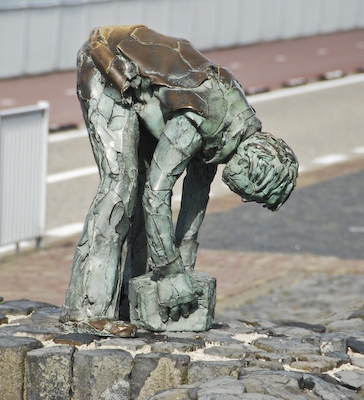
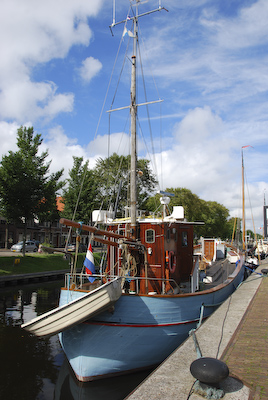
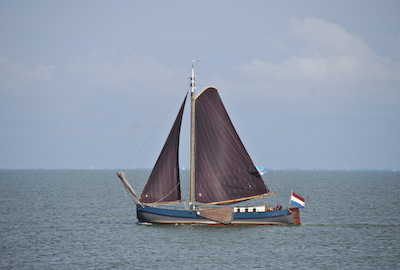
Many communities around the shores of what used to the the saltwater Zuiderzee lost their livelihood when access to the open sea was shut off.  Some of the fishing boats that now sail the Ijsselmeer hoist dark-brown sails as a sign of mourning for their lost sea fishing.
Midway along the dyke’s length, at the point where it was completed in 1932, stands a monument to “the men who put their backs to the task”, and a monument to Dr. Lely.  Tourists can stop for a snack at the charming cafe in the base of the tall tower or cross the pedestrian bridge over the road for a great view of the project from the North Sea side.
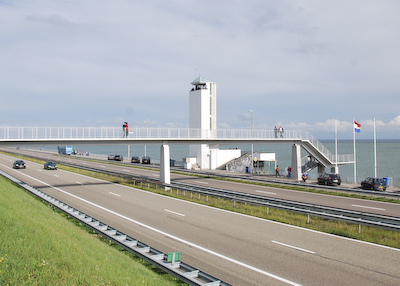
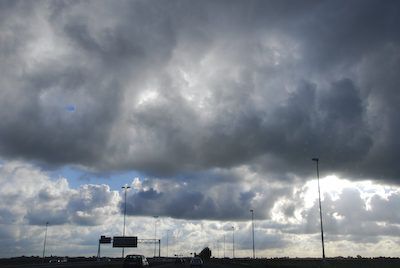
We stopped at the parking area near the bridge to take photographs and explore what was there.  We walked across the bridge to look at the North Sea.  Surprisingly, it was calm despite the stiff breeze.  Perhaps the Wadden islands were doing their job.  Afterwards, we continued to drive to the end of the Afsluitdijk, then we made a U-turn and drove back south on the dyke toward Amsterdam and Delft.  The sun was setting and huge dark clouds were rolling in from the west as we approached Delft.  It had been a good day.
September 11th In The Netherlands

September 11th, 2010

Saturday – September 11th

It was a beautiful sunny morning and we checked out of the Van der Valk Hotel. Nearby, just north of Utrecht and near the hotel, we found a two-star “Driving Tour” in the Michelin Guide of the Loosdrechtse Plassen.  This is an area of lakes called the “Water Garden of the Netherlands” which were created by flooded peat bogs with a history reaching back to the 14th century.  There are castles, farms, splendid villas, and yacht yards. Apparently the word ‘yacht’ is a Dutch word.  The circuit roads go around the huge lake and we drove through the towns of: Breukeleveen, Loenen, Vreeland, Oud Loosdrecht, and Sypesteyn. We had driven most of the circuit roads yesterday in the rain on our way to Utrecht, but we wanted to see it today in the sunshine.

Earlier in the trip, a small icon of a wrench and a mechanic appeared on the dashboard.  We assumed it meant that it was time for the car to have an oil change and we ignored it.  This morning another larger “wrench” icon appeared on the dashboard during our drive around the Loosdrechtse Plassen. I was worried about the car and our liability, and since we were so close to the Hertz office at Schiphol Airport, we drove there to tell them about the icons.  The young manager was called and he assured us that the car was just overdue for an oil change and would be alright for the weekend. He put his signature on our contract and we drove off, feeling relieved of our responsibility if the engine seized-up because of lack of oil.

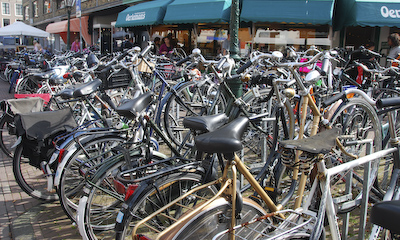
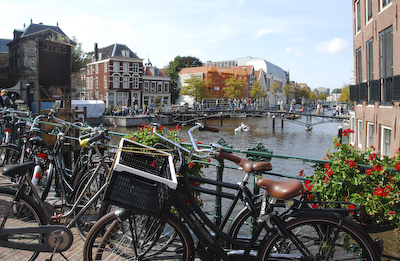
On our way to south Delft, we decided to stop at Leiden again.  We wanted to see the town and the beautiful architecture of the buildings and the museums, without the market which was there the last time.  Oops!  It was another Saturday and we forgot the routine of European markets.  Since it was a bright and sunny day, the market was overflowing with people and bicycles!  There must be more bicycles than people in the Netherlands.  A bicycle parking lot in Leiden:

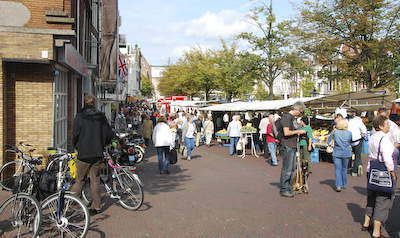
Markets are fun and we enjoyed this one again.  It’s interesting to see that there are sections of the same goods for sale in these markets.  I suppose it has to do with the longevity of the sellers who have probably been at a particular site for many years, perhaps generations.  For example, there is one section where all the stalls sell fish, another section for clothes, another one sells cheese, another for bread.  I guess that makes it easier for the locals who do their weekly shopping here.

Leiden is a lovely university town with wide canals and beautiful architecture.  On market day there are lots of people and activities.  The people are courteous and the atmosphere is relaxed and casual, especially on a warm sunny day!

We ate a good sandwich lunch in the square of the Town Hall Restaurant.  The Town Hall is actually used as a restaurant in the summer and tables are set in the outdoor area of the old historic building.

We continued south toward Delft, our destination for the night.  We had enjoyed staying there at the beginning of this journey and we thought it would be fun to return there for our last weekend in the Netherlands.  We had made a reservation at the Hampshire Hotel – Delft Centre on the Internet the night before.

There is something to be said for “familiarity” when you’re away from home.  It feels good to know where you’re going and where you’ll be staying for the night.  The Hampshire Hotel is modern and comfortable and the people are friendly and nice. It was also a good base because it is centrally located. It is a short walk into Delft centre for restaurants, shops, etcetera, and a few minutes drive to the main highways.

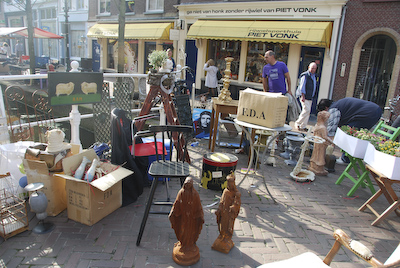
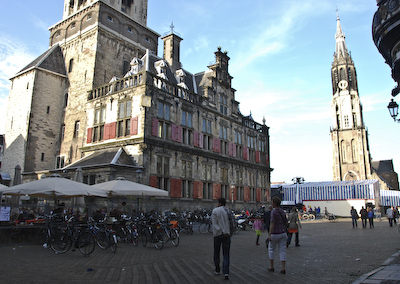
It was Saturday “antiques” market day in Delft and also the national holiday of Open Monument Day, when all the museums and monuments are open free of charge to the public. The little streets were crowded with people.

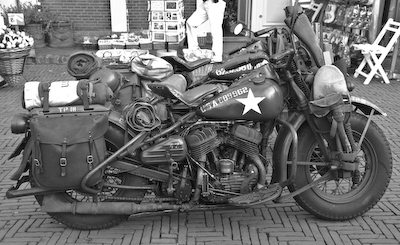
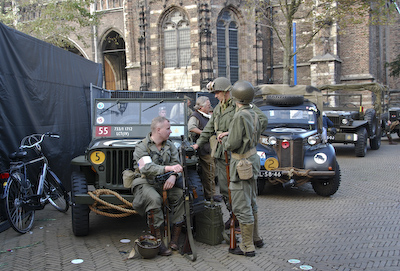
Huge bleachers were set up filling the entire Markt square in the center of town. There was going to be evening entertainment of military marching bands and demonstrations of WWII military trucks, jeeps and artillery.  They were still selling tickets, but neither Jeff nor I were interested.

We looked for an outdoor cafe for dinner and found the Waag behind the Stadt Huis, which was the old “weighing house” for gold and silver from 1770.  The temperature was a bit cool, but we had an enjoyable outdoor supper.  For the first time we noticed that people were eating dinner early (before 9:00 PM) and realized that they were planning to go to the military show at eight.

After dinner, we were slowly walking back to the hotel and enjoyed the excitement of the crowds of people who were rushing to go to the show.  It was  a little strange to see men in WWII uniforms sitting at cafes and milling about.  Their old American vehicles were parked along the street.  We felt like we were in an episode of Masterpiece Theater or Foyle’s War.  I suppose Delft might have looked like this during or right after the war.  A sad thought…..

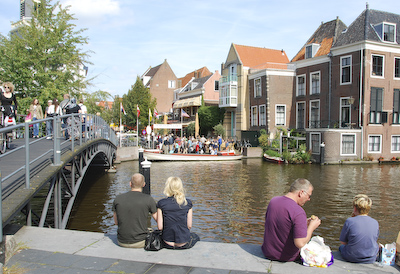
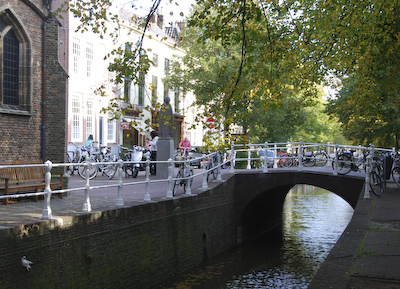
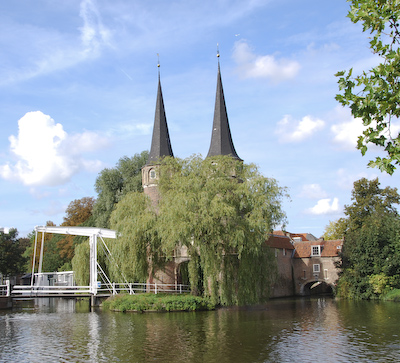
Delft is a beautiful town with interesting streets and canals to explore.  It isn’t overly touristy, despite the tourists, and I could see returning to Delft again in the future.


Coming Home to Breukelen

September 10th, 2010

September 10th Friday – Cool and Rainy – 15 degrees Celsius

It’s another rainy day in the Netherlands. I recently asked a woman in a shop, who was complaining about the rain, if this was typical weather or something out of the ordinary. She shrugged and said that rain and overcast cloudy skies was typical Dutch weather. Oh well…. I wondered if it ever got warm enough for all the boats to be used or were they around for atmosphere and wishful hopes.  Last year, when we visited Amsterdam we had several rainy days in July.


We awoke early and left the Crown Plaza Hotel in Maastricht by 9:15 AM. Jeff got the car out of the parking garage and we had coffee at a local shop. We easily found the A2 highway and drove north. It was only a two hour drive to Utrecht. If the weather had been nicer we might have had a leisurely breakfast in Maastricht or stopped off in Utrecht to see the sights in the early afternoon.

It was a gentle rain, “misting” as they called it in Scotland, but persistent enough to interfere with taking photographs. The A2 is one of the Netherlands major north-south highways which ends in Amsterdam. It passes several good-sized cities and towns, but most of the views are of farms and industrial parks.

We had made a reservation at the Van der Valk Hotel in Breukelen because all the hotels in Utrecht were booked solid three days ago for the entire weekend. Something exciting must be going on in Utrecht this weekend, but we don’t know what!!

Breukelen is about 8 kilometers north of Utrecht just off the A2. It is the town where the early Dutch settlers in the New World got the name for their new city in 1646: Brooklyn. In a strange way, it could be considered a “home coming” for Jeff to get back to his roots since he was born in Brooklyn, NY. I read an Internet article that Breukelen celebrated the anniversary of their Brooklyn connection last year in 2009.


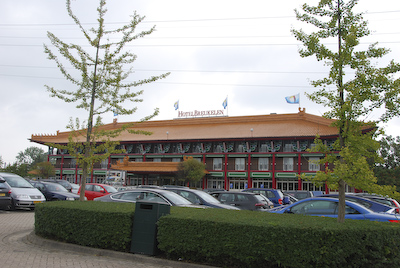
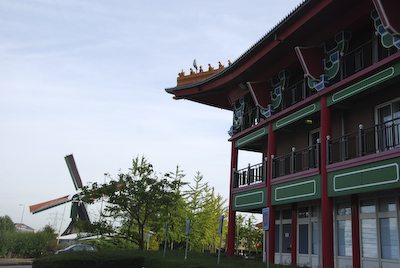
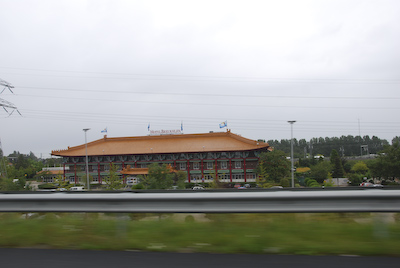
Jeff had read in Trip Advisor that the hotel was right off the A2 and had the distinction of Chinese architecture. As we were driving north we hoped that we would be able to find it easily. Then we spotted it! Yes, it’s a large building painted red with a yellowish tile roof with sweeping curves and looks like something from the Forbidden City in Beijing China and a big neon sign “Hotel Breukelen”.

It was impossible to miss!! It even had the small Chinese Imperial figures on the lower corners of the roof. If it’s not raining tomorrow, I will take pictures of it. It was a laugh! The building is a real surprise on the Dutch highway in the middle of green farms dotted with white sheep and brown cows, where the exit sign reads: “Breukelen”. We were very disappointed that the Chinese theme was not continued inside the hotel. There is nothing Chinese in the lobby, or restaurants, or the rooms. We were hoping for a Chinese menu in the restaurant, at least…… Hmmm, I wonder if there is a suggestion box somewhere.


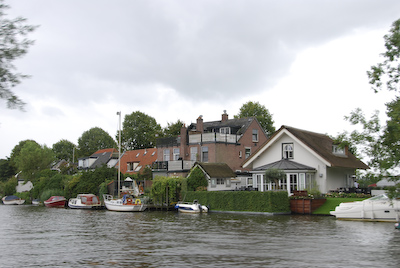
In the afternoon we drove through Breukelen and it’s nothing like its namesake in New York. We took a driving circuit recommended by the Michelin Guide which went through some very beautiful areas north of Utrecht. If the weather had been better, we would have stopped in one or more of the lovely villages and took pictures. There were many large beautiful houses along the shores of the lakes. It looked like a boater’s paradise with many sail and power boats.


Afterwards we drove into Utrecht. There was a lot of traffic and congestion on the A2 southbound. I guess rainy Fridays exist everywhere. Utrecht looked like a typical Netherlands city with industrial areas on the outer perimeter. Then modern residential areas around the “ring roads” and finally an old historic “Centrum” in the middle or heart of the city. The other drivers are polite and drive relatively slowly so driving on the narrow older streets isn’t too hard.

It’s the bicycles and motor-scooters that make driving in any Netherland city a challenge. They simply seem to have the right of way and do not stop at traffic intersections! Pedestrians do have the right of way and when they step off the curb, drivers have to stop their cars. This combined with driving in an unfamiliar place makes driving a bit of a challenge.


We returned to the Van der Valk Hotel in the early evening to blog and rest. This hotel is part of a chain and I wondered if the other hotels look like this one or if they have different building themes. The owner of the chain must have a Walt Disney imagination or a weird sense of humor.


Ubi Bene, Ibi Sum

September 9th, 2010

September 9th – Thursday: Cloudy & Rainy: 12 – 17 degrees C

Maastricht, Netherlands was another interesting Dutch city to learn about and explore. The Michelin Guide said that Maastricht is the “bustling cosmopolitan provincial capital of Limburg.” The original settlement on the Maas River continued to grow from Roman times.

Maastricht, Netherlands

It has been a college town since 1976 and the student population “gives the historic town a vibrant feel and exuberant character”. Today, Maastricht continues its old tradition as a “busy Medieval center on an important trading route” with many modern shops and stores in the central part of the town.

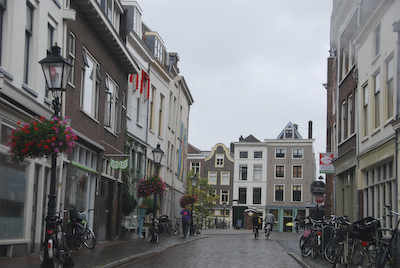
We walked around Maastricht to explore the sights and learn about the city.  The buildings are an interesting blend of modern and historic.  The old streets are narrow and very clean.  There are bicycles everywhere!  Like most Dutch villages, all the people, young and old, ride bicycles or motor-bikes anywhere and everywhere.

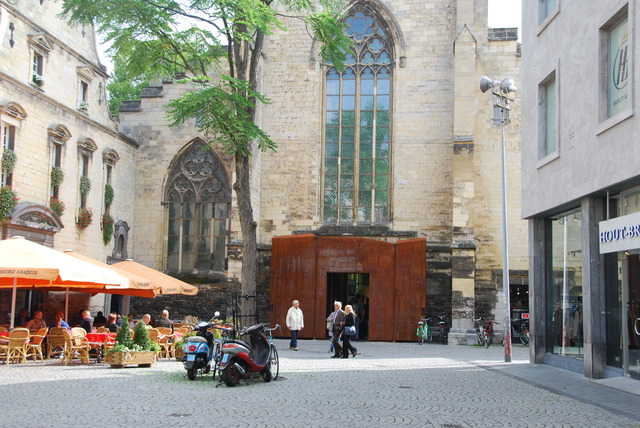
Entrance to the Book Store

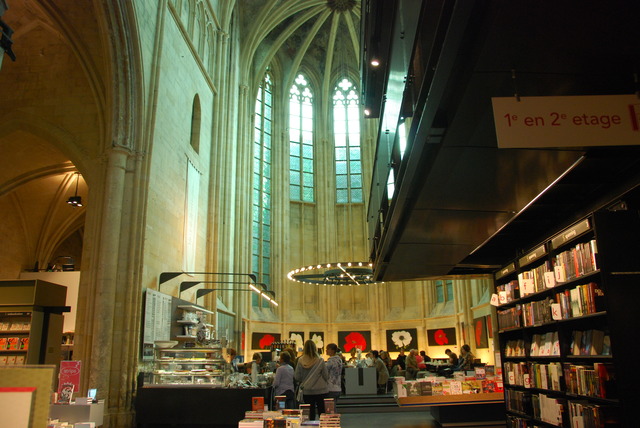
As we explored, we found “the most beautiful book store in the world”.  Jeff had read about it in the guide but we didn’t know where it was.  So we were surprised to find it by chance!

Interior of the Book Store

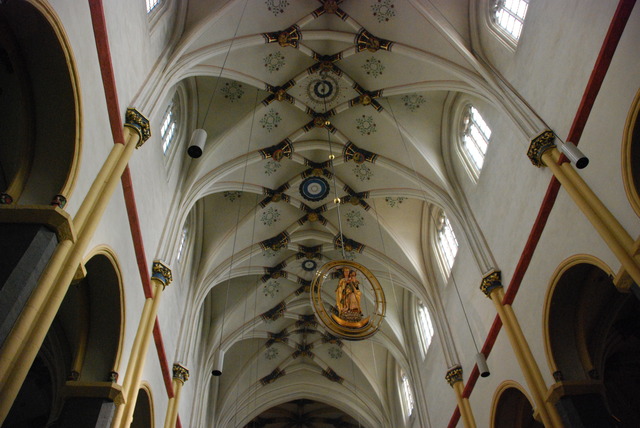
The book store was in a lovely old church, with the high Romanesque arched ceiling and stained glass windows.  There was no sign outside or identifying label that it was a book store.  Two levels of book shelves had been built inside the middle of the church.  There was a cafe with tables and chairs in the head of the church where the alter must have been.  The entire effect was quite lovely.  All it needed were comfortable chairs to sit on and read.

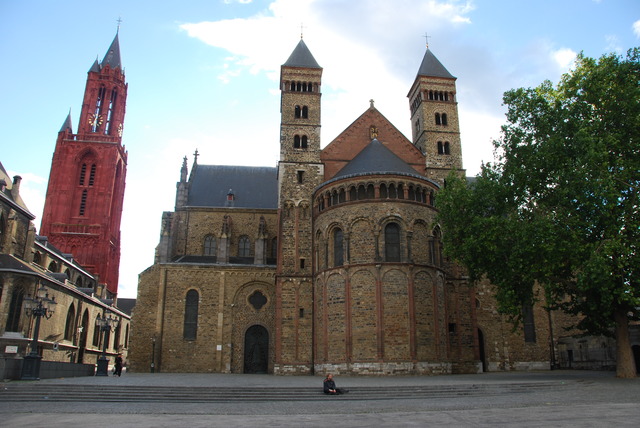
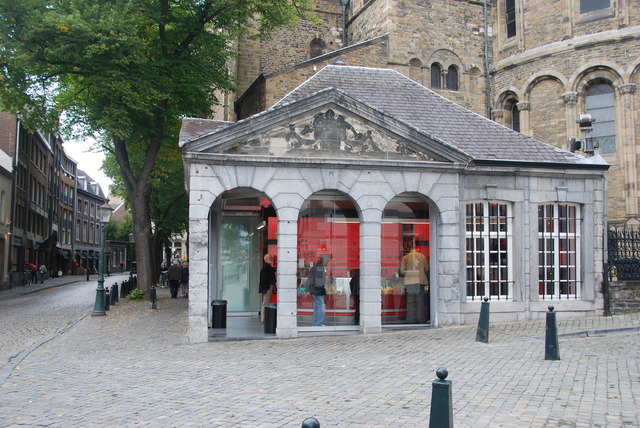
Saint Servaas Basilica

The most famous sight is St. Servaasbasiliek (Saint Servatius Basilica) located on the Vrijhof, the main market square of Maastricht. The interesting information about St. Servatius is that historians believe he was born in Armenia. He was a bishop in the Roman Catholic church and he transferred his bishopric to Maastricht in 382 and is credited with bringing Christianity to the region. The first church was built on top of his tomb after he died in 384.

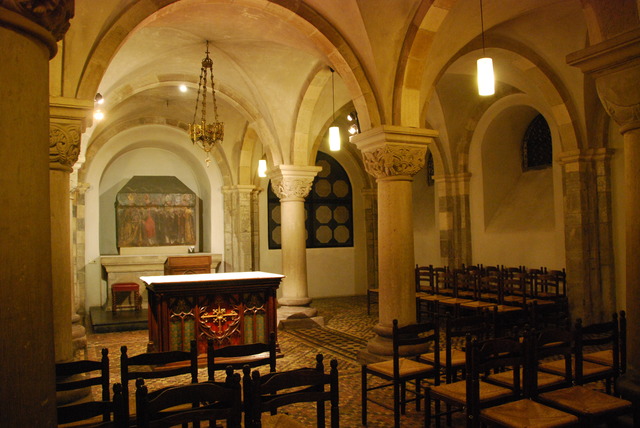
The Chapel Under the Nave

St. Servatius’ remains are in the crypt which is under the nave of the Basilica. The pillars of the 6th century sanctuary which was built in his honor are still part of the chapel. Construction of the original church began in about 1000 AD and the existing Basilica was expanded to its current size in the 12th through 15th centuries.

We found the entry doors by accident and paid an admission fee of about 3 euros each. The first rooms we saw were the “Treasury” which was located in the collegiate chapel from the 12th century.

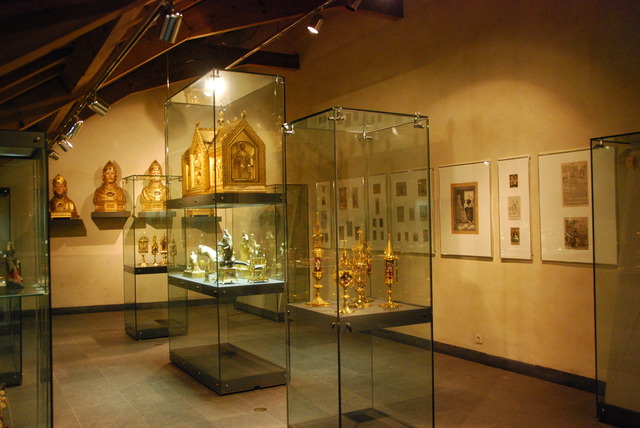
The Treasury

This was an impressive collection of liturgical objects made of gold, silver, and ivory displayed in glass cases. Then we walked around the lovely 15th century cloister and into the church. As soon as we opened the large heavy door, we were met by the strong scent of incense, just like an Armenian church! Ahhh, I thought, the spirit of the Armenian St. Servatius is still here….. We had visited many other churches and none of them had the same incense as this in the air of the sanctuary. It was the same incense that is used in Armenian churches.

Ceiling of St. Servaas Basilica

We listened to a young woman practice playing the lovely organ and we left quietly. Then we had a delicious fresh lunch in a modern cafeteria on the street level near all the bright shops. We were tired and walked back to the hotel to rest for a few hours.

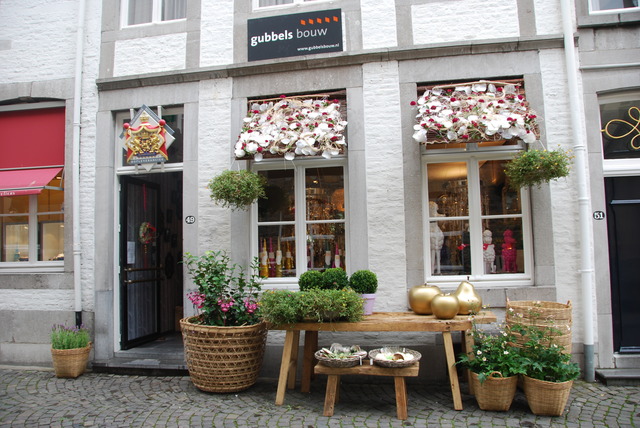
Just a Pretty Shop

About 6:00 PM we went out again to walk around and have a nice last evening in Maastricht. There was some blue sky when we started out, but then the large black clouds moved in and it started to rain. We entered John Mullen’s Irish Pub and had a couple of Strong Bows and waited out the rain.

Last night the streets of Maastricht were empty, but tonight there were crowds of people everywhere. We finally realized that on Thursday nights, the stores are open until 9:00 PM. We explored some more and looked at the buildings with construction dates of 1723 or 1709, etcetera, written on them.

La Bonne Femme

Then we walked by the River Maas and found a restaurant for dinner: La Bonne Femme. We haven’t had a bad meal in Holland, or all of Benelux, and this was also delicious! There was a bright red gelateria nearby and we stopped for gelato. We leisurely walked back to the hotel eating our gelato.

Gelateria

One of the houses along the river had a marble plaque above the front door which read in Latin: Ubi Bene Ibi Sum.  Literally it means: Where it’s good, here we are.  I thought of several interpretations.  I like the idea of ‘where ever we are, it’s good’.  A good end to a good day……

Finding Maastricht, NL

September 8th, 2010

September 8th Wednesday: Rain showers on and off all day: 12 – 15 degrees Celsius

Breakfast was included with our room at the Eden au Lac, so we enjoyed their elegant buffet breakfast in the fancy dining room under the white Murano glass chandelier. The Eden au Lac Hotel (I never saw the lake!) was really a resort where people went to spend a week or at least several days. They ate all their meals there, walked on the trails, swam in the pool, sat in the lounge, and did whatever else resort people did. The hotel people tolerated us transient people, because they weren’t fully booked, but they really weren’t especially happy with us…. They kept inviting us to come back when we had more time to spend more time there, etcetera. Actually, our room was on the “warn” side. It had seen better days. However, the bathroom had been totally updated with new fixtures and shiny gray marble walls and floor.  The bathroom was so modern that it didn’t match the dated, but cozy, bedroom.

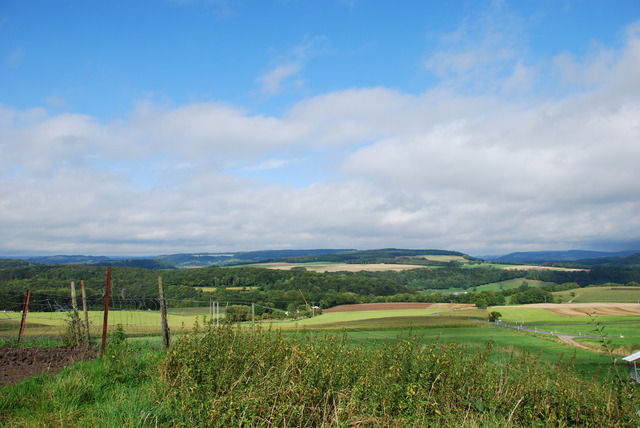
Luxembourg Countryside

We checked out about 10:00 and drove north along the good Luxembourg roads. We had read about some castles or “chateaus” along the N-10 road and wanted to see them. The weather was cloudy with large dark clouds passing quickly overhead.

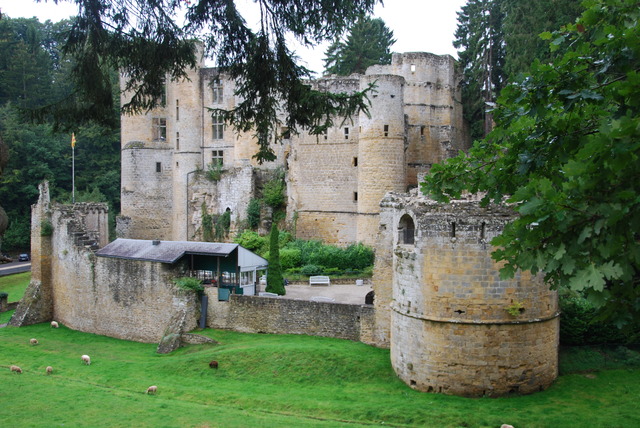
The Chateau Beaufort

The first was Chateau de Beaufort, located about 6 kilometers off the main road in a lovely valley. Beaufort is a lovely town with a population of about 1,370 people. The castle was built in the 12th century and restored by the governor of Luxembourg in the 16th century.  Today, it is mainly in ruins, but has a restaurant and a few empty rooms to explore.  Although the light was not so good because of the clouds, we still took photos of the outside.  We decided not to go into the chateau but to continue driving.

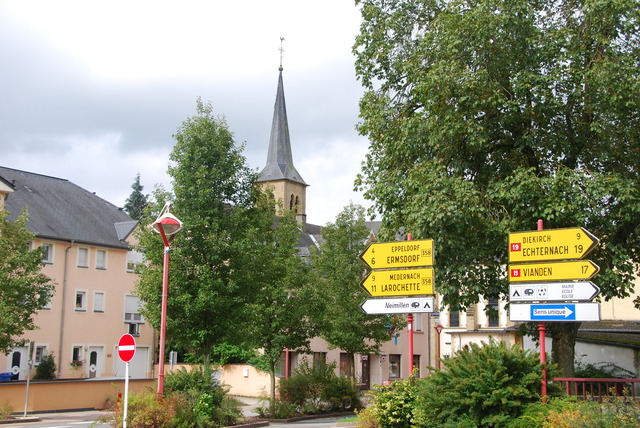
An Intersection in Luxembourg

The weather seemed to improve and the sun peeked out intermittently. We drove on the E-421north of Diekirch and onward to the Chateau Bourscheid.

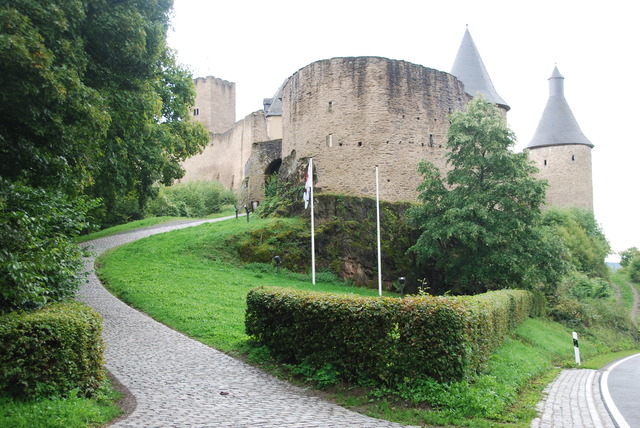
The Chateau Bourscheid

This castle was in better condition than the Beaufort due to the fact that it had been recently renovated and was owned and operated by the government today. The Chateau Bourscheid has its origins in the 11th century, when it consisted of a tower building linked to a chapel. The long surrounding wall with its watchtowers was completed in 1384 when a separate residential building was designed for the masters of Bourscheid.
It was threatening rain so we decided not to pay the entrance fee and go into the chateau and we walked back down the hill to the parking lot. We continued north along the main north/south N-7 road through the beautiful countryside of Luxembourg.

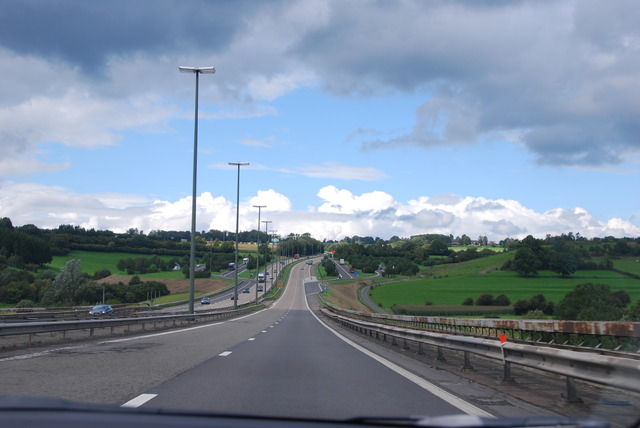
The Luxembourg Highway

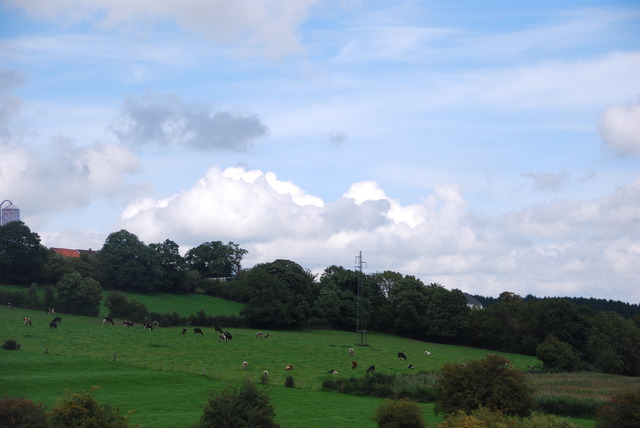
The land is hilly and there are many fields and farms in the distance. It is a pleasant road which goes through many small and lovely villages.


We crossed the border back into the Netherlands (Holland) several hours later and followed the signs to the city of Maastricht. We had a frustrating time trying to find the Crown Plaza Hotel because of their vague directions on the Internet, which stated that the hotel was along the river on Ruiterij #1.

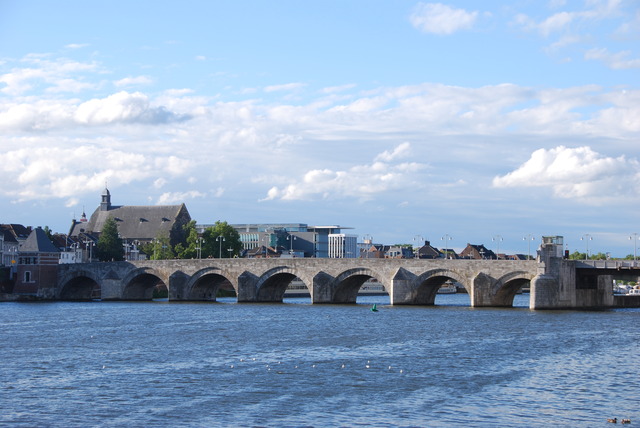
The Bridge Over the Maas River

The directions left out the fact that you could not drive along the riverbank, and that the Ruiterij street was a small cul de sac located just in front of the hotel.

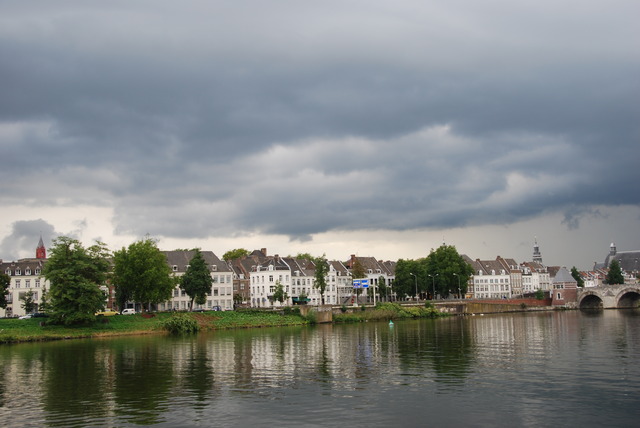
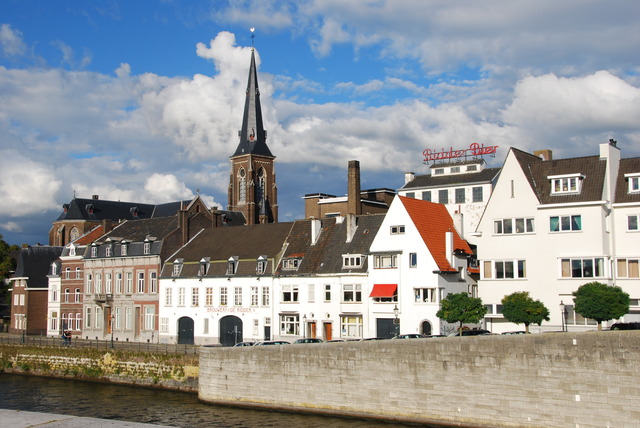
Houses Along the Maas River in Maastricht, NL

We found the hotel by some stroke of luck Jeff spotted it from the other side of the river and we figured out how to get there on a car bridge and we finally checked in.

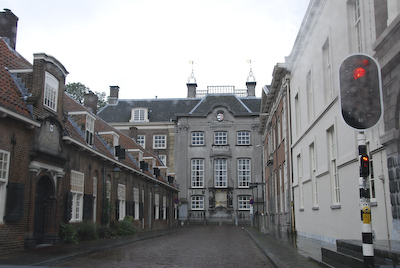
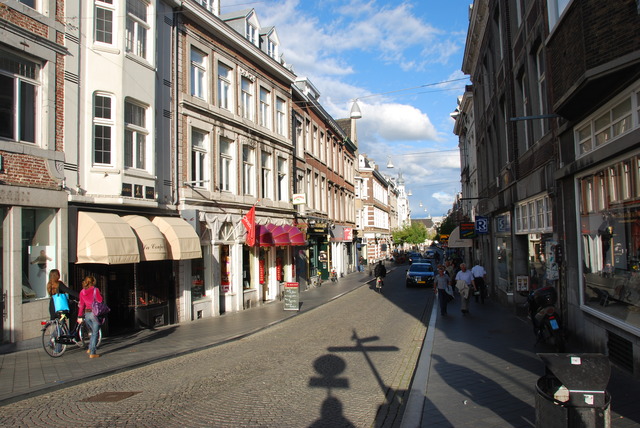
Typical Street in Maastricht

We went out in the late afternoon to explore and find a restaurant for dinner. We found the main market square which was lined with restaurants on one side.

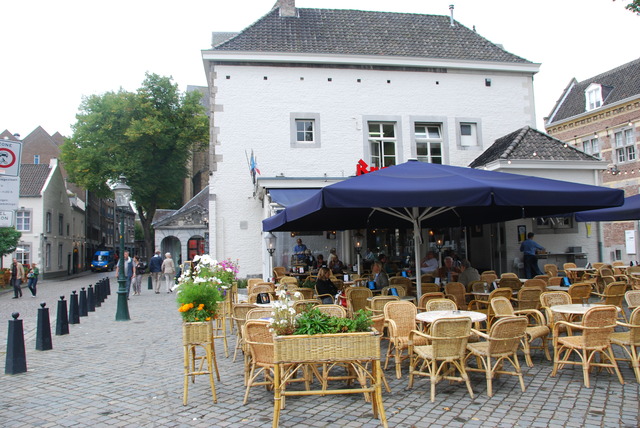
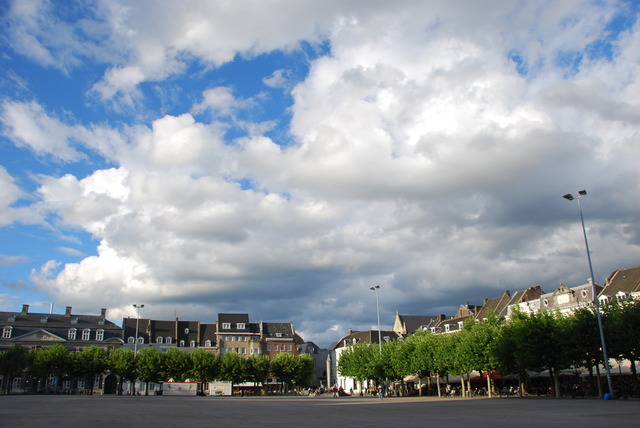
Markt Square

We chose a restaurant and had a good dinner. “Frites” (French fries) seem to come with every meal no matter what you order, which is OK since they’re so good!  But there’s no ketchup –  just mayonnaise and salt.  Maastricht is a pretty city and the historic center is a fun place to explore.

The View From Our Table in the Markt